The Hard Ball Myth: Is Sydney's Rise Really Built at the Coalface?
Sydney sit 13-4 and the easy line is that they're winning the grind. The evidence says the grind is the one place they've never dominated.
Sydney's 2026 season has revived an old claim about the Swans — that their success is forged in the contest, at the hard ball, in the trenches. With a 13-4 record and a top-of-the-table look, the narrative writes itself. But the club's ten-year contested-ball history and this season's own numbers tell a more complicated story about where the wins actually come from.
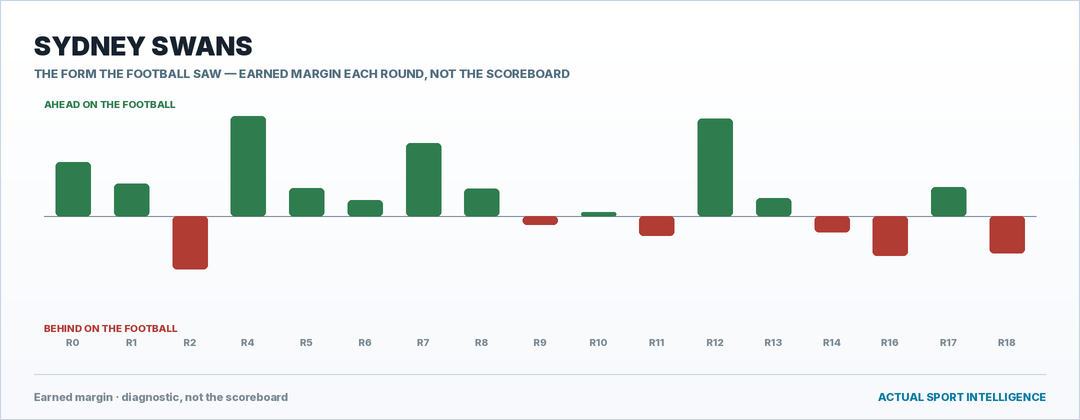
Watch Sydney closely and the contest isn't where the game tilts. This season they're essentially level at the coalface — 139 contested possessions to their opponents' 138, barely a nose in front and sitting mid-pack for it. That's not a side bullying the footy off the deck.
Where they hurt teams is with ball in hand. The engine's plain read of their season is a group that moves the ball at will and finishes cleaner than the quality of their looks suggests. They score off transition and shape, not off winning three-in-five at the coalface.
The wobble, when it comes, is in control — holding the game on their terms once they've got it. So the football on show isn't a contested-ball story. It's a ball-movement story wearing a contested-ball headline.
Let's be precise. This season Sydney rank 10th of 18 at the contest, +1.2 a game — statistically indistinguishable from even. You cannot build a 13-4 explanation on a coin-flip category.
The longer record is sharper. Since 2017, Sydney have won the contested-ball count in 4 of their last 10 seasons and played finals in 7 of the last 10. The engine holds those two figures separately — it does not tell us how many finals years carried a contest edge, so nobody should claim a neat overlap. What we can say is that contest dominance and success have not moved together for this club.
The honest statement: contested ball is not the variable doing the work here.
Set against the club's own baseline, 2026 looks familiar, not freakish. Their strongest contested year on record was 2025 — +2.2 a game — and it returned a 10th-place finish. Their best table results have come from elsewhere.
The archive's loudest note is 2024: a top-four finish built while ranked 14th of 18 at the contest, losing it a full three possessions a game. That's not a team that finished high despite a bad day at the coalface — that's a team that finished high while being beaten there all year.
So the idea that Sydney success rides the contest doesn't match the standard they've actually set. Their winning template has repeatedly been built somewhere other than the hard ball.
When a side is level at the contest but converts better than its chances deserve, the players changing the story aren't the ones winning the ground ball — they're the ones using it and finishing it.
The hidden contributors here are the transition players and the forwards taking the looks. Sydney have been clinical all year: they turn average entries into scores at a rate above what the raw quality suggests. That's a finishing and delivery trait, not a contest trait.
So if a contested-ball winner is being handed the headline for Sydney's rise, the headline is on the wrong player. The genuine difference-makers are further up the ground and in front of goal — the ones converting territory the side earned by moving it, not by clawing it off the deck.
Here's the outcome-bias trap. Sydney are 13-4, so we go hunting for a tough-and-hard explanation to match a successful side. The contest sounds like the right kind of virtue for winners.
But strip the ladder position out. On the contested ball alone — 10th of 18, a shade over even — this is an unremarkable profile. If Sydney sat 8-9, that same +1.2 would be read as a weakness, and rightly so. The number hasn't changed; only the record framing it has.
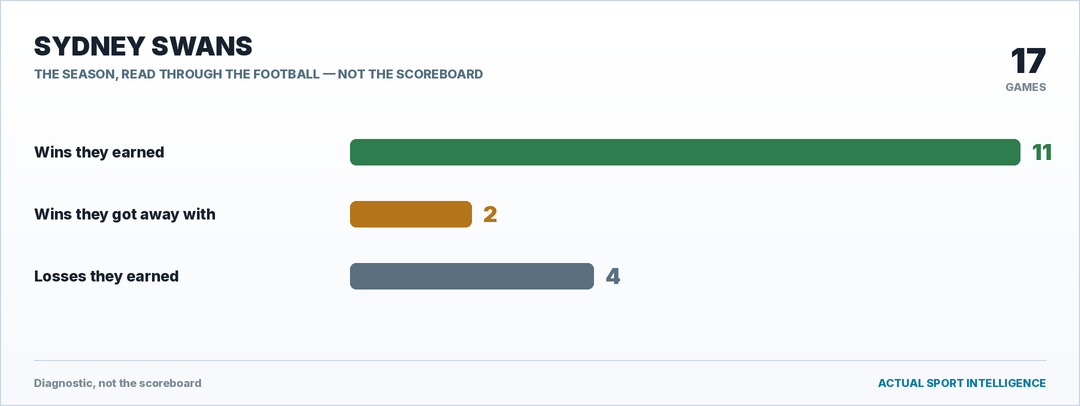
And the engine is blunt about how the record was built: 11 wins they earned, 2 they got away with, 4 losses they earned. That's a genuinely strong season — but it's a season won on ball movement and conversion, not one the scoreboard should let us reassign to the coalface.
Push back on the room. Being level at the contest isn't nothing. Look at 2019 — Sydney were last of 18, losing the hard ball by eleven a game, and the season collapsed to 15th. That's the floor when the contest caves in.
So the case against the room is this: maybe Sydney don't win because of the contest, but they can't win without at least breaking even at it. This season's +1.2 might be the platform that lets the ball movement function. Correlation isn't the same as irrelevance.
The rebuttal has limits, though. In 2024 they finished top-four while being beaten at the contest by three a game — so even the 'floor' argument has a live exception. Contested ball may be a threshold, not the engine. But dismiss it entirely and 2019 is the reminder waiting.
Beneath the topic is a simple mismatch between what feels true and what the evidence carries. Sydney win, so we reach for the honest-graft explanation — the contested ball, the coalface, the hard stuff. It's the story we tell about successful teams.
But every seat keeps landing in the same place from a different angle: this is a ball-movement and conversion side that happens to break even at the contest. The football eye sees transition. The archive sees 2024's top-four built while losing the hard ball. The player lens points up the ground and inside 50.
The central contradiction is that Sydney's identity has been misfiled. The headline says 'built on the contest'. The evidence says 'built while the contest stayed roughly level'. Those are not the same claim — and the gap between them is the actual story.
What the room agrees on
The room broadly agrees that Sydney's 2026 success is not built on dominating the contested ball. This season they sit 10th of 18 and barely ahead of even at +1.2 a game — a coin-flip category, not a strength. The club's own history reinforces it: their best contested year (2025, +2.2) returned 10th, while their 2024 top-four run came with them ranked 14th and losing the hard ball by three a game. The football on show, the finishing numbers and the player roles all point to ball movement and clean conversion as the engine, not the trenches.
Where the room still has tension
The tension sits with the Counter-Case. Being level at the contest may not be the reason Sydney win, but 2019 — dead last, minus eleven a game, a 15th-place collapse — hints that caving in there sets a floor they can't afford to hit. Is the contest irrelevant, or is it a threshold that simply hasn't been breached this year? The 2024 top-four built while being beaten at the contest complicates even that, and the engine gives us the finals count and the contested-ball-win count separately without telling us how they overlap. That gap is real and unresolved.
What the evidence carries
What survives all seven seats is this: the claim that Sydney's ladder success is built on winning the contested ball does not hold. They're level there, they've historically been level or worse there, and their standout seasons were won elsewhere — through ball movement and a genuine knack for converting better than their chances deserve.
What the evidence can't settle is whether the contest is truly irrelevant or quietly load-bearing — a floor they need to hold rather than a lever they pull. 2019 says don't dismiss it; 2024 says don't overrate it.
So the honest shape is a strong 13-4 side (11 earned, 2 got away with, 4 losses earned) whose success has been mislabelled. Whether you call the contest a non-factor or a silent threshold, the rest is yours to weigh.
Why it matters — How you name a side's real strength decides whether you understand its run or just admire it.