Port Adelaide And The Contested Ball: A Myth Worth Testing
The idea that Port live or die at the coalface is a tidy story. Ten years of their own numbers tell a messier one. Is the contest really the engine?
Port Adelaide sit 6-11 through 17 games of 2026, and a familiar theory follows any Power side around: their success rises and falls on winning the contested ball. We put the claim through the room — this season's contest numbers, a decade of Port's own contested-ball ledger, and the football underneath both.
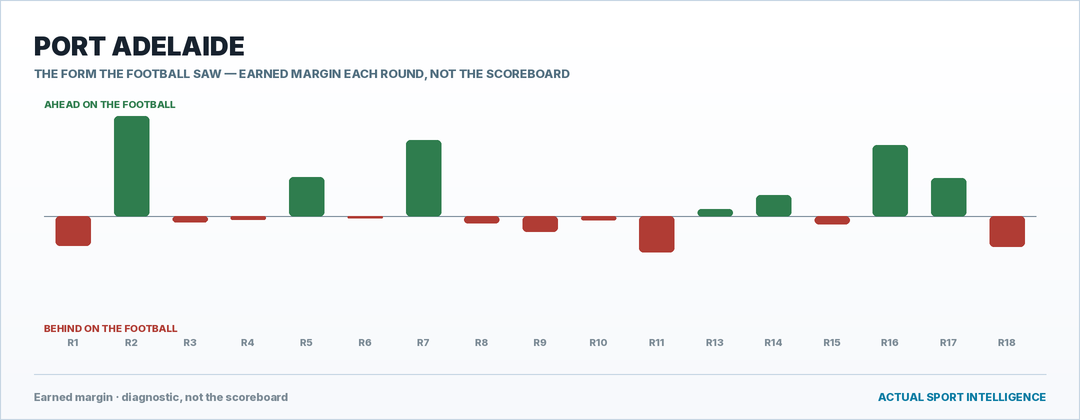
Watch Port in 2026 and the eye lands somewhere unexpected. Their best football has come when they move the ball at will — chaining possession, using space, getting it forward on their terms. Where they slip is control: holding a game, keeping the tempo theirs, protecting a lead.
The contest itself? This season they're broadly even at the coalface, winning roughly 123 contested balls for every 127 the opposition wins — 13th in the league. That's not a strength you'd build a house on. It's a side that's neither dominating nor being buried at the stoppage.
So the football on show doesn't match the theory. When Port look dangerous, it's ball movement doing the damage. The contest is a floor they're standing on, not the lever they're pulling.
Here's the cleanest test we have: ten seasons of Port's own contested-ball ledger against where they finished. If success were built on the contest, the two would rise and fall together. They don't.
In 2020 Port were 3rd in the league at the contest, +6.5 a game, and finished 1st — the theory's dream season. But in 2024 they finished 2nd on the ladder while ranking 15th of 18 at the contest, losing it by three a game. Same club, near-identical success, opposite contest profile. Across the last ten years they've won the contested-ball count in only five, yet made finals in five as well — and the two lists don't neatly overlap.
That's the signal that matters: output at the contest and position on the ladder have moved largely independently. One season proves nothing either way; the decade is the sample, and the decade is quiet on the claim.
The claim feels intuitive because contested ball sounds like the honest currency of footy — the hard stuff, the stuff that should win games. But measured against Port's own history, winning without owning the contest is not the exception. It's part of the pattern.
The temptation with a contested-ball narrative is to hang it on a name — the inside midfielder who wins the hard ball and drags the side with him. But the evidence here doesn't hand us that player, and inventing one would be dishonest.
What the numbers do point to is collective: Port's identity this year is built on moving the ball, and their softest area is control. That's a structural, whole-side story, not a single-hero one. It suggests the players changing games are the ones who use the ball well in transition, not necessarily the ones winning it at the bottom of a pack.
There's also a quiet cost worth naming — Port have been leaving points out on the ground, scoring less than the quality of their chances is worth. Whoever's finishing, or not finishing, is shaping outcomes as much as whoever's winning the contest.
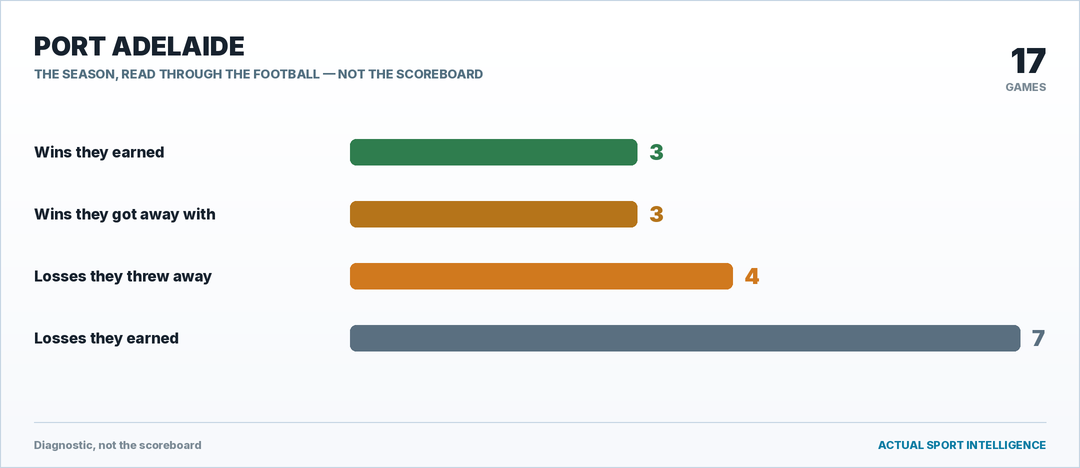
Port are 6-11, and a losing season invites a tidy cause. "They're not winning the contest" is an easy one to reach for. But look closer at how those results actually broke down: three wins they genuinely earned, three they got away with, four losses they threw away, and seven losses that were fair. That's a season with real slippage on both sides of the ledger, not a simple contest failure.
Here's the outcome-bias trap. This year they're -3.5 at the contest and struggling. In 2024 they were -3.0 at the contest — almost identical — and finished 2nd. If the scoreboard had smiled this year, the same modest contest deficit would be a footnote, not a headline. The result is colouring how we read the coalface, not the other way around.
Strip the emotion of the ladder position and the contest numbers this season are ordinary, not catastrophic.
Let me put the sharpest version of the opposing case, because the room shouldn't dismiss it too easily. There is one alignment that supports the believers: 2025. Port were dead last but one at the contest, -12.6 a game, and finished 13th. When they were truly buried at the coalface, the season collapsed with it.
So the honest challenge is this: maybe the contest doesn't matter until it does. Maybe modest deficits like -3.0 or -3.5 are survivable, but fall off a cliff — down near -12 — and no amount of ball movement saves you. Under that reading, the contest is a threshold, not a dial. Port can lose it a little and win; lose it a lot and everything breaks.
That's a real argument. It doesn't rescue the simple "success is built on the contest" line, but it means we can't declare the contest irrelevant either.
Pull the six reads together and a shape appears. The believers point at 2020 and 2025 — the years the contest and the results agreed. The doubters point at 2024 and this season — the years they didn't. Both are looking at the same club and seeing different truths because they're reaching for different seasons.
The synthesis is this: the contest isn't Port's engine, it's their floor. Their actual success has ridden on ball movement and how well they convert what they create. When they move it well and finish, they win regardless of the coalface. When the contest deficit stays modest — around three a game — they can absorb it. Only when it caves in completely, as in 2025, does it drag the whole season under.
So the headline shouldn't read "success built on the contest." It should read "success built elsewhere, provided the contest doesn't collapse."
What the room agrees on
The room broadly agrees the simple claim doesn't hold. Ten seasons of Port's own numbers show contest output and ladder position moving largely independently: 1st off a strong contest in 2020, but 2nd off a losing contest in 2024. This season's -3.5 at the coalface is ordinary, not disastrous, and the football on show says Port's best work comes from moving the ball, not grinding out stoppages. Success being 'built on' the contest overstates a link the decade doesn't support.
Where the room still has tension
The tension is real and it's worth keeping. The believers have 2025 — when Port collapsed to -12.6 at the contest and the season fell apart with it. That points to a threshold: modest contest deficits are survivable, a total collapse is not. So is the contest irrelevant, or is it a floor that only bites when you fall through it? The room can't fully settle that from the evidence here, and pretending otherwise would be dishonest.
What the evidence carries
What survives the whole review is this: the popular line — that Port's success is built on winning the contested ball — asks the contest to do work the decade shows it hasn't done. The years of genuine success don't cleanly track the years they owned the coalface, and a near-identical contest deficit gave them 2nd in 2024 and a 6-11 struggle in 2026. Something other than the contest is deciding these seasons.
What the evidence can't fully carry is the extreme. 2025 says that when the contest truly collapses, everything else collapses with it — so 'irrelevant' overstates the doubters' case as much as 'foundational' overstates the believers'.
The most honest frame is the contest as a floor, not an engine: Port build wins on ball movement and finishing, and only need the contest to stay close enough not to sink them. Whether that makes the coalface a genuine cause or merely a limit is the line the numbers leave open — the rest is yours to weigh.
Why it matters — How you frame Port's foundation changes what you'd actually try to fix — the stoppages, or the way they move and finish the ball.