St Kilda Earned This One — And the Football Had Them Further Ahead Than the Scoreboard
Fourteen points on the board, closer to twenty-four in the contest. Seven angles on a St Kilda win that was more comfortable than the margin let on.
Round 18, 2026: St Kilda 87 defeat Port Adelaide 73. On the surface, a two-goal game between a middling Saints side and a struggling Power. Underneath, the football pointed to a clearer story — and this is the room pulling it apart.
This one was settled where St Kilda have always wanted to settle games: at the contest and with the tackle count. They won the contested ball and laid tackles at a rate of roughly three to two over Port. That's not a stat line, that's a temperament — the Saints made Port earn every possession and then hunted it back the moment it spilled.
Territory ran their way too, if only slightly — they had the front half a fraction more often and carried the ball a touch further. The picture is a side that squeezed the game into its own image: heavy pressure, ground-level ownership, forward-half footy. Port could move it when given room, but St Kilda kept taking the room away.
Take the single game on its own and you have modest edges: contested ball, tackles well up, territory marginal, metres near-level. Nothing there is a blowout. What lifts it above noise is the quality-of-chances read — St Kilda's looks were worth about 99 to a scored 87, Port's worth about 74 to a scored 73. So the Saints created more than they cashed, and Port took roughly what they built.
That's why the football had St Kilda by about 24 rather than the 14 on the board. It's a defensible gap, not a fabricated one. But treat it as a signal, not proof — one match can't carry a season's worth of certainty. The 17-game backdrop does more of that work.
Set against the season, this fits St Kilda's shape perfectly. Six of their eight wins this year have been earned on the football, only two got away with — this is a side that, when it wins, tends to deserve it. So an earned win over a struggling opponent isn't a departure; it's the baseline.
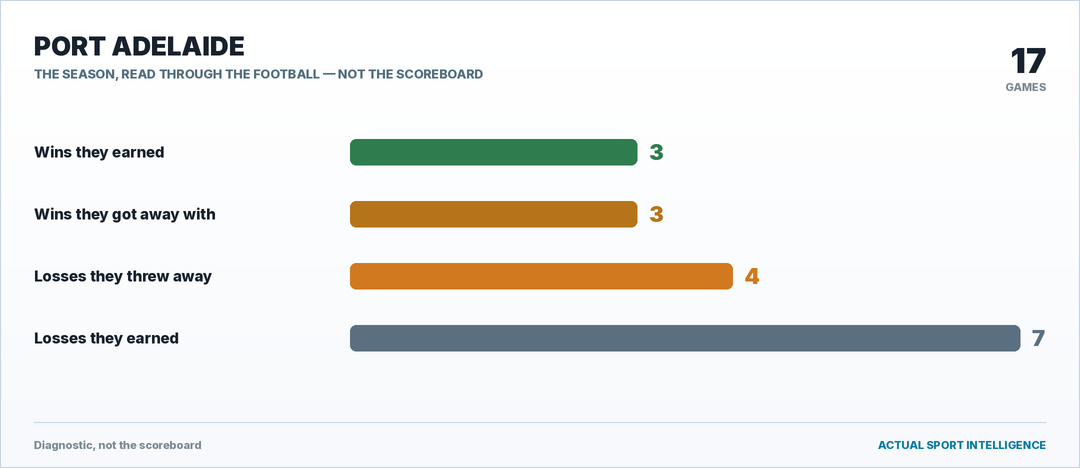
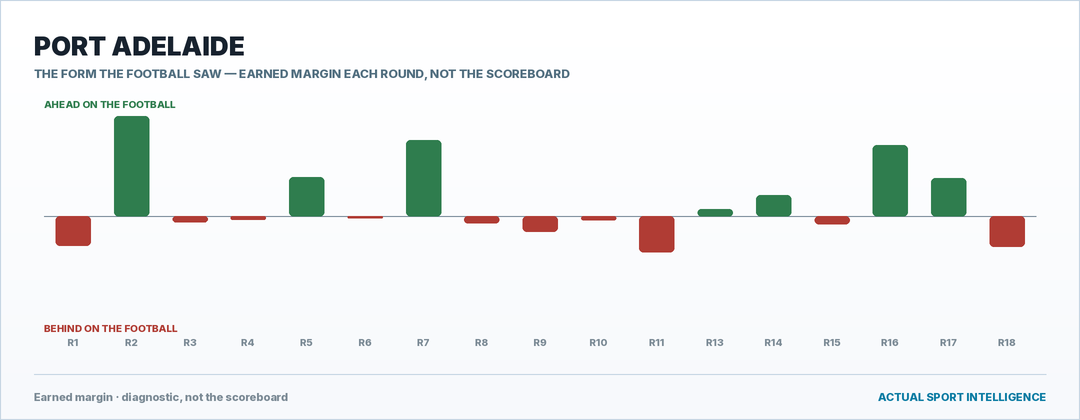
Port's ledger tells the other half. Six wins from 17, and of their eleven losses, seven were earned — losses that matched the football. A group whose best trait is moving the ball but whose weakness is control ran into a side built to break exactly that. Measured against expected standards, the outcome is unremarkable. What's mildly unusual is that a 14-point margin flattered the loser.
St Kilda's swing came through Nasiah Wanganeen-Milera with Bradley Hill and Hugo Garcia — the ball-carriers and territory-winners who turned pressure into forward-half footy. That trio didn't just accumulate; they moved the game where the Saints wanted it, which is why the metres and entries tilted their way.
For Port, Jason Horne-Francis and Aliir Aliir were the reasons the scoreboard stayed civil — one driving contest, one holding the back half together. But two men fighting the tide is exactly what an earned loss looks like. When your best players are your defensive spine and your engine-room, and the margin still slips out, the headline names are carrying the result, not shaping it.
This is the useful test. Had Port nicked it late, the story would've been 'gutsy Power upset', and it would've been wrong. The chance quality had St Kilda at about 99, Port at about 74. A Port win would have been a heist, not a triumph — the kind of result that lands them in the 'got away with' column rather than the earned one.
So the 14-point margin isn't contaminating us much here; if anything it's under-selling St Kilda. The danger with this game runs the other way: don't let the tightness convince you Port were close. They scored roughly what they built and still lost by two goals. The scoreboard is honest about the winner — it's just quiet about the size.
Push back on the '24-point' picture and it softens. The raw contest edge was narrow, territory barely tilted, metres almost level. The gap widens only through the chance-quality read — and both these sides share the identical failing this year: they leave points on the ground, scoring fewer than their looks are worth. So St Kilda's inflated chance figure partly reflects a season-long habit of wastefulness, not just superiority on the day.
And who was the opponent? A 6-11 Port side whose defining weakness is control walked into a pressure game and lost control. Beat a struggling team by two goals and the honest question is how much is St Kilda being good versus Port being poor. The earned label is fair; the scale of it is doing a lot of lifting.
Strip it back and there's a clean contradiction at the centre. The scoreboard says tight two-goal game; the football says comfortable. Both are true — and the gap between them is the story. St Kilda controlled the contest, the pressure and the territory, built the better chances, and still only won by 14 because they, like Port, keep leaving points out on the ground.
So the headline isn't 'Saints surge' or 'Port fight'. It's a side playing to type — earning its wins the hard way at ground level — beating a side also playing to type, undone by the control it can't find. The margin is the misdirection.
The honest frame: this is confirmation, not revelation. Two known identities met, and the more disciplined one won by more than the board admits — against opposition that made it easier.
What the room agrees on
The room is settled on the core: this was an earned St Kilda win, not a fortunate one. They won the contested ball, dominated the tackle count, edged territory, and — crucially — built better-quality chances (worth about 99 to Port's 74). Flip the score and the football still points the same way, which is why the room trusts the winner. The 14-point margin understates a game the Saints largely controlled, and both the single game and the season ledger (six of St Kilda's eight wins earned) tell the same story.
Where the room still has tension
The tension is over scale and cause. The Football Read and Scoreboard Read see a comfortable, undersold win; the Counter-Case notes the raw edges were narrow and the '24-point' picture leans heavily on a chance-quality figure inflated by St Kilda's own season-long wastefulness. And there's the opponent problem — this was a 6-11 Port side whose defining weakness is control walking into a pressure game. How much is St Kilda good, how much is Port poor? The room can't fully separate the two.
What the evidence carries
What survives all seven seats is this: St Kilda earned it, and the scoreboard is quieter about the win than the football was. That's not in serious dispute. The contest, the pressure, the chance quality all point one way.
What the evidence can't settle is how much to be impressed. Two sides who both waste chances met; the more disciplined one won, but against an opponent built to lose exactly this kind of game. The margin misled toward closeness; the underlying numbers may mislead slightly toward dominance.
So you're left with a confirmed identity rather than a revelation — St Kilda winning the way St Kilda wins. Whether that reads as a genuinely strong performance or simply competence against a struggling side is the call the evidence hands back. The rest is yours to weigh.
Why it matters — It's a reminder that margins lie in both directions — a tight scoreboard can hide control, and a control edge can hide a weak opponent.