The Crows Are Winning — Just Not Where You Think
Adelaide sit 11-6 and the story writes itself: hard-nosed footy, won at the coalface. The evidence tells a quieter, stranger story about where this season actually comes from.
Adelaide have long been a club whose ladder position rose and fell with the contested ball. In 2026 they're winning again — so the room asks whether the old engine is still doing the work, or whether this success is built on something else entirely.
Also in this story

Watch Adelaide this year and the eye keeps landing on transition, not the contest. Their best work is done moving the ball at will — clean chains, ground gained, shape in the forward half — and they finish what they create. The engine reads them as clinical: they convert better than the raw quality of their chances suggests.
The coalface tells a flatter story. This season they've split the contested ball almost exactly even with opponents, sitting mid-pack in the competition on that count. That's not a side crashing packs into submission; it's a side that's happy to break even in the trenches and beat you on the outside and in front of goal.
Where they slip is control — the tighter, grind-it-out phases. So the football picture is a team winning through movement and conversion, carrying a contest game that's merely level.
Let's be precise. Adelaide's contested-ball differential this season is +0.1 a game — statistically indistinguishable from level — and they rank 11th of 18 at it. Yet they're 11-6. Those two facts sitting side by side are the whole point: you cannot build a case that this success is contest-driven when the contest is a coin flip.
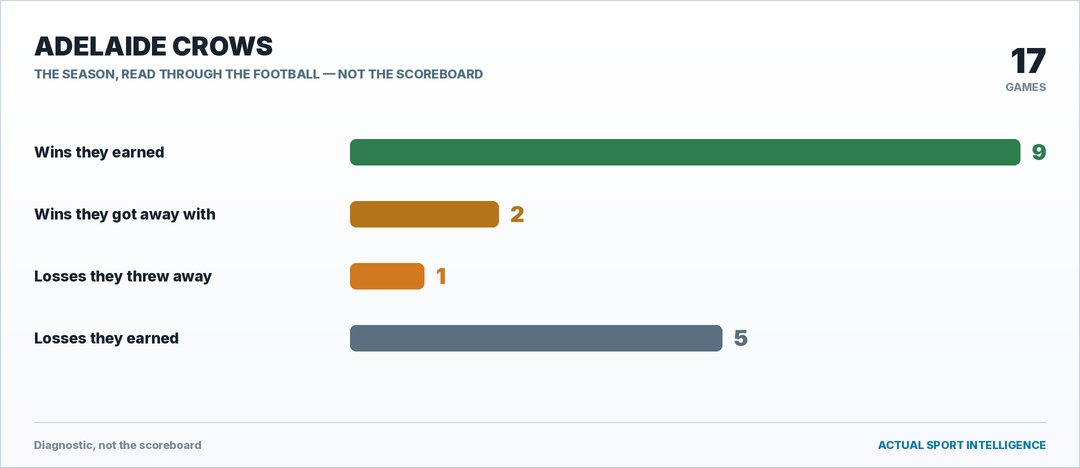
The quality of the wins backs it. Of the 17 games, the football reads nine as wins they genuinely earned, two they got away with, and only one loss they threw away. That's a real record, not a lucky one — but the earning is happening somewhere other than the coalface.
The honest caveat: 17 games is a season, not a decade, and identity signals can shift. But on what we have, the contested-ball explanation has outrun its evidence.
Here's what makes 2026 stand out against Adelaide's own archive. Since 2017 they've won the contested-ball count in seven of their last ten seasons, and their stronger finishes tended to arrive with it. Their peak contest year, 2017, came with a +4.2 edge and a top finish. Their worst, 2020, was -7.4 a game and a wooden-spoon season.
So for this club, the coalface and the ladder have usually risen and fallen together. That's the baseline. A good year normally meant a good contest year.
2026 breaks the pattern — 11-6 while merely level at the contest. There's a precedent for the mismatch, but the other way: in 2021 they ranked mid-pack at the contest and finished 15th. Winning without owning the contested ball isn't Adelaide's historical shape, which is exactly why the old story feels true even as it stops fitting.
If the contest is level, then the players carrying this season aren't the ones the headline usually celebrates. The lift is coming from whoever is moving the ball cleanly through the middle and hitting the scoreboard — because Adelaide's edge this year is transition and conversion, not extraction.
That matters for how we hand out credit. A contest-first read hands the season to the inside grunt. But the numbers point the praise elsewhere: to the runners and connectors who turn even ball into gained ground, and to the forwards making a clinical side clinical.
Without individual splits in front of us, we can't name them precisely — that's an honest limit. But the shape is clear: the players doing the load-bearing work are on the outside and up forward, not solely at the coalface where the reputation lives.
This is where outcome bias does its damage. Adelaide are 11-6, so we reach for a flattering explanation and grab the most footy-macho one available: they win the hard ball. But run the counterfactual. If they were 6-11 with the exact same +0.1 contested differential, nobody would be crediting the contest — they'd be saying Adelaide can't win it where it matters.
The contested-ball number hasn't changed; only the scoreboard has. That's the tell. A genuine cause holds regardless of result. This explanation only appears because the wins are there to justify it.
Strip the scoreboard glow and what's left is a side dead-level at the coalface who wins through movement and finishing. The record is earning it — nine clean wins is real — but the reason we're tempted to say 'contested ball' is the wins talking, not the tape.
Let me push back on the room. 'Level' isn't 'irrelevant'. This season Adelaide are +0.1 and 11th; not long ago, in 2020, they were -7.4 and 16th of 18. If they've dragged the contest from a genuine weakness up to par, then the contest is part of the story — the foundation that lets the ball movement work. You can't run clean transition off a coalface you're being beaten senseless at.
And the club's own history is stubborn: seven of ten seasons winning the count, the better finishes arriving with it. Maybe holding the contest even is precisely the platform, not a bystander.
Where this breaks down: 'enough to not lose it' is a very different claim from 'the success is built on it'. Being no longer beaten at the contest is a floor. It's not the engine — and the room shouldn't let 'necessary' get promoted to 'the reason'.
Here's the shape beneath it all. Adelaide have a decade-long identity — win the contest, climb the ladder — and it's true enough that everyone reaches for it. But 2026 is the year the identity and the method came apart. The wins are real; nine of them genuinely earned. The contest is level. Those don't contradict — they redefine.
The central tension the room keeps circling: is a par contest the platform that frees the ball movement, or just a neutral fact that has nothing to do with why they're winning? The Counter-Case says foundation; the Evidence and Scoreboard reads say the earning happens elsewhere — in transition and in front of goal.
So the headline shouldn't read 'built on the contested ball'. It should read 'winning despite a contest that's only level' — a clinical, ball-moving side whose reputation hasn't caught up to its method.
What the room agrees on
Every seat accepts the frame: Adelaide are genuinely 11-6 with nine earned wins, and this season they're only level at the contested ball — +0.1 a game, 11th of 18. The room agrees the wins are real and the coalface is not where they're being won. It also agrees this is unusual for the club, whose ladder and contest have historically moved together, from the +4.2 peak of 2017 to the -7.4 collapse of 2020. The best work is being done through ball movement and clinical conversion, not extraction.
Where the room still has tension
The live tension is what 'level' means. The Counter-Case argues that dragging the contest up from a past weakness to par is itself a platform — the floor that lets the transition game function, which makes the contest part of the story even if it isn't dominant. The Evidence and Scoreboard reads counter that 'not losing it' is a long way from 'built on it', and that we only credit the contest because the wins arrived to flatter it. Necessary versus decisive — the room won't collapse that gap for you.
What the evidence carries
What survives all seven seats is this: the claim that Adelaide's success is built on winning the contested ball does not hold for 2026. They're not winning it — they're level — and they're winning anyway, through movement and finishing.
What the evidence can't settle is how much that level contest matters. It may be a quiet foundation that makes everything else possible, or it may be a bystander getting credit the scoreboard bought it. We can see the differential and the record; we can't see inside the causation with 17 games and no player splits.
So hold both truths: the old identity is real history, and it's the wrong lens for this season. The engine has changed even if the badge hasn't. Whether you call a level contest a platform or a footnote — the rest is yours to weigh.
Why it matters — How you read this season decides whether Adelaide keep building around the contest or around the game that's actually winning them matches.