The Dogs Won The Contest For A Decade. This Year They're Winning Without It.
Western Bulldogs built a reputation at the coalface across ten seasons. But the 2026 side sits 15th of 18 for contested ball and is still 10-7 — so what is this year's success actually built on?
The Western Bulldogs are long known as a contested-ball club, and since 2017 their best finishes have tended to arrive when they win the ball in tight. This season complicates the story: they're losing the contest badly yet sitting 10-7. The room examines whether the 'success built on the contest' idea still describes the current side, or just the badge on the jumper.
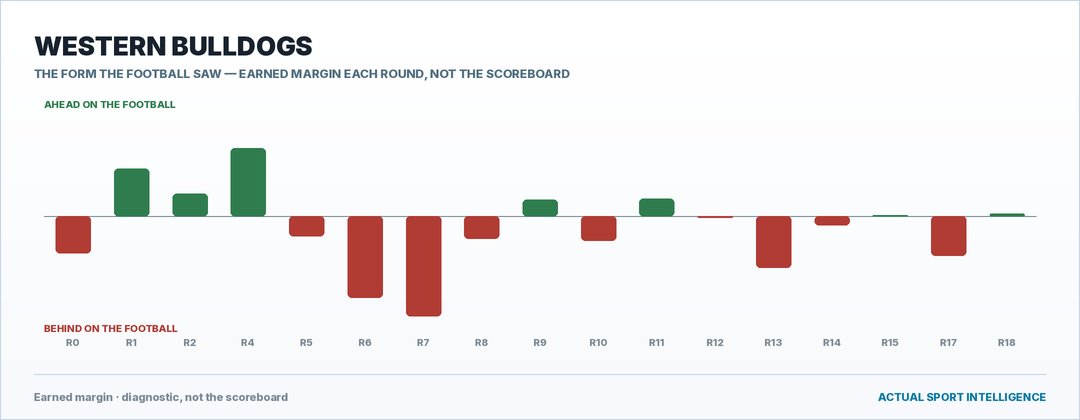
Watch this year's Bulldogs and the football tells you where they live. Their best work comes from moving the ball at will — springing it out of defence, linking through the corridor, hurting sides on the transition. Where they slip is when they have to disrupt the opposition's flow. That's an attacking identity, not a contest identity.
The coalface numbers back the eye. They're winning a shade under half the contested ball, 15th of 18 for the season, and giving up nearly six of those tight wins a game. A genuine contested-ball side does not sit there.
The honest football read: their record is real, but the mechanism behind it in 2026 is ball use, not muscle in the clinch. The contest is the thing they're overcoming, not the thing they're built on.
Start with what's solid. Across the last ten seasons the Bulldogs have won the contested-ball count in seven of them, and played finals in seven. That's a genuine pattern, not a fluke of one year — for this club, the coalface and the ladder have generally moved together.
But a ten-year correlation is not a law, and 2026 is the exception standing in the doorway. They're -5.9 a game at the contest, 15th of 18, and still 10-7. That single season doesn't overturn the history, but it does show the link can break.
Worth adding: their finishing this year has roughly matched the quality of chances they create. No hidden luck inflating the scoreboard, no hidden waste dragging it down. The record looks earned on that measure — just not earned at the contest.
Set the archive out and the shape is clear. The Dogs' peak contest year was 2021: nearly eight extra contested wins a game, third in the league, a top-five finish. Their floor was 2018: beaten by six-and-a-half a game, 16th of 18, dropping to 13th on the ladder. The pattern held — when they owned the ball in tight, they climbed.
Against that baseline, 2026 is the odd one out. Fifteenth of 18 is closer to their 2018 low than to any of the years the club built its name on.
So the interesting thing isn't that they win the contest — it's that this side is 10-7 while losing it. That's not their historical winning standard reappearing. It's a different route to the same win column.
This is where the room has to be straight with you. The material here is team-level — season record, contested-ball counts, an identity read. There are no player names, no role-by-role numbers, nothing that lets anyone point to who is winning what.
What the shape of the season implies is that the difference-makers are more likely to be the ball-users and rebounders than the pure inside grunt — because the side thrives on moving the ball and struggles when it has to disrupt. But that's an inference from team identity, not a measured player contribution.
So the truthful answer: we can see the team is winning without owning the contest, but we cannot say from this evidence which players are carrying that or which are only carrying the headline. Anyone naming a hero here is guessing.
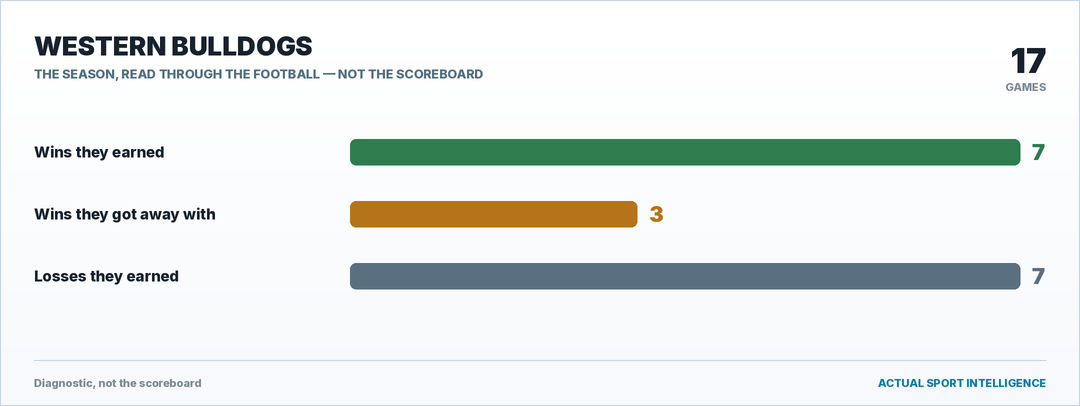
Here's the outcome-bias trap. A 10-7 record invites the reassuring story: winning side, contested-ball club, the machine works. But split the wins the way the football actually falls and it reads differently — seven wins they genuinely earned, three they got away with, and seven losses they earned outright.
Strip the three fortunate wins and this is a 7-7-ish football team, not a comfortable finals lock. The scoreboard is rounding up.
That matters for the contest question because the win column is doing a lot of the persuading. If two of those close ones had tipped the other way, we'd be writing about a side that can't win the contest and can't close games. Same football, different headline — which is exactly the signal that the record, not the mechanism, is shaping the reading.
Let me make the case the room is circling around. Seven of ten seasons winning the contest, finals in seven — that's not noise, that's a club whose success has ridden on the coalface for a decade. One down year doesn't dismantle a pattern that strong. Dismiss the premise and you're throwing out ten years for one.
And look harder at 2026. The one thing they can't do is disrupt the opposition. Losing nearly six contested balls a game is a plausible cause of that weakness, not a coincidence beside it. When you don't win it in tight, you don't stop the other side's flow.
So the challenge stands: maybe the contest still is the foundation, and the three wins they got away with are precisely the price of not winning it. The record survives despite the contest, not because they've found a better way.
Underneath the question is a confusion of timeframes. 'Built on the contest' is true of the Western Bulldogs as an institution — a decade of evidence says so. It is not obviously true of the Western Bulldogs playing right now, who sit near the bottom of the league at the contest and win, when they win, by moving the ball.
That's the central contradiction. The badge says coalface; the 2026 side says transition. Both things are real, and the headline collapses them into one.
The sharper framing isn't 'is their success built on the contest?' It's: this club is winning against its own identity, propped up partly by a record that's rounded up three notches. Whether that's a reinvention or a warning sign is the argument worth having — and it's a live one.
What the room agrees on
Everyone accepts the ten-year pattern is real: seven of ten seasons winning the contested ball, finals in seven, the club's strongest years arriving at the coalface. And everyone accepts 2026 breaks it — 15th of 18, nearly six contested balls down a game, yet 10-7. The current identity is ball movement, with disruption the weak point. There's no hidden luck or waste in the finishing; the chances created and taken roughly match.
Where the room still has tension
The tension is what to make of the one down year. Webb notes the record is flattered — only seven of the ten wins are genuinely earned, three were got away with. Marsh pushes back that losing the contest may be exactly why they slip and why the wins are shaky, so the premise survives as a diagnosis of their ceiling. Chen reframes it as two different teams wearing one name. And Morrison flags the honest gap: nobody here can say which players are actually driving it.
What the evidence carries
What the evidence carries: this is a club with a decade-long contested-ball identity, and a 2026 side that is currently winning without it. Both statements are true, and the headline question hides the fact that they describe different things.
What it can't settle: whether winning against their own identity is a genuine reinvention or a fragile run held up by three fortunate wins and a soft contest number. The counter-case that losing the coalface is capping this side is live, and there are no player-level numbers here to break the tie.
So if you mean the club's history, the contest is central. If you mean this team, right now, the football says otherwise — and the record is rounding the story up. Which of those two Bulldogs you're really asking about decides the answer, and the rest is yours to weigh.
Why it matters — How you read this decides whether 2026 is a clever new way to win or a warning that the old engine has stalled.