The Bulldogs Won By 16. The Football Had It At 2.
Western Bulldogs beat West Coast by 16 points and the engine still stamps it earned — but the football underneath had this as a coin-flip the Dogs simply made count. A win that looks comfortable — and wasn't.
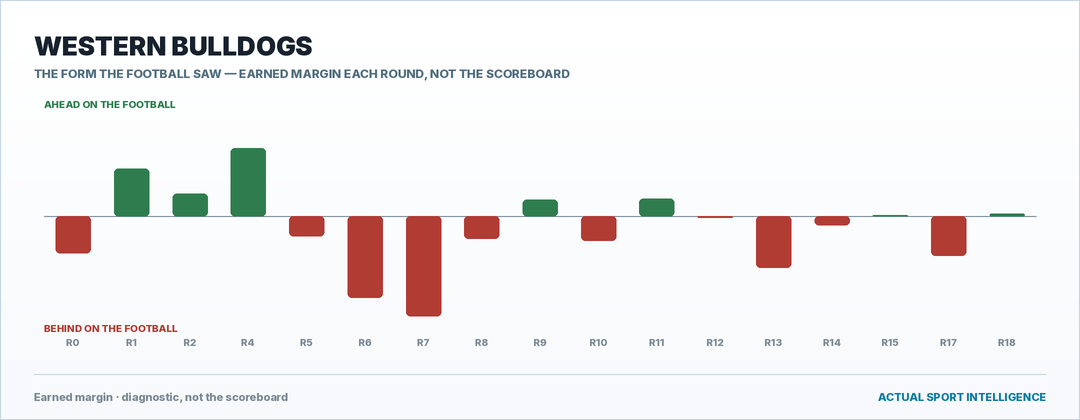
Round 18, 2026: Western Bulldogs 86 defeated West Coast Eagles 70. The scoreboard says 16 points. The quality of the chances says something tighter — the Dogs' looks were worth about 81, the Eagles' about 79. It carries the 'True Win — Earned' stamp, yet the football had the margin closer to two goals than three. The room pulls that apart.
Strip the scoreboard away and this was a win built on transition, not muscle. West Coast actually shaded the contested ball — the Dogs won only a shade under half of it — and the Eagles laid more tackles, so the coalface belonged to the visitors. Territory split almost dead even, a few entries apart either way.
Where the Bulldogs pulled ahead was in ground gained. They carried the ball noticeably further, turning broken play into forward-half time without ever dominating the clinches. That's the club's fingerprint: win the run, not the wrestle.
So the football showed a side that got its scoreboard from ball movement and finishing, while giving up the contest. Handsome to the eye, thinner underneath.
The number that matters here is the gap between what happened and what it looked like. The scoreboard read 16; the quality of the looks each side created had it at about two. The Dogs scored 86 from chances worth roughly 81 — slightly clinical. West Coast managed 70 from chances worth about 79 — plainly wasteful.
That's the whole story of the extra margin: the Eagles left points out there. It isn't evidence of a class gap.
This is one game, so resist building a thesis on it. What's safe to say is narrow and firm — the Dogs deserved the win, and the size of it is an accounting quirk of goalkicking, not a measure of superiority.
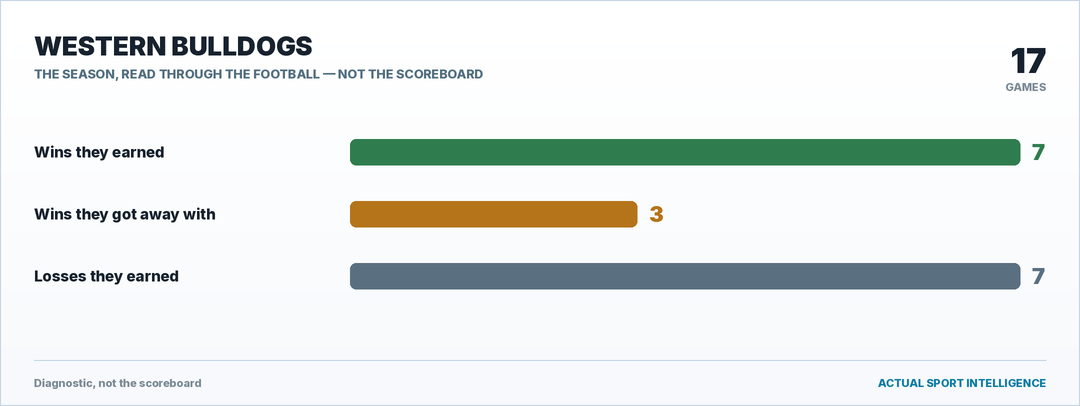
Set it against the Bulldogs' own year. At 10-7, the football's ledger reads seven wins they earned, three they got away with, and seven losses they earned. This one lands in the earned column — but at the slim end of it, not the convincing end.
Against a winning standard, that matters. Sides that play deep finals tend to turn close performances into clear ones, or at least win the contest while they're at it. This was earned by a whisker and against the run of the coalface.
So it's not a mirage — but it's not a marker of a rising side either. It's a competent team doing enough on a day the opponent helped.
The Dogs' win had three fingerprints on it. Bontempelli and Ed Richards did the engine work through the middle — fitting for a side that scored off its ball movement — and Aaron Naughton did the punishing at the end of it. That trio was the difference between a two-point football day and a 16-point board.
Across the other side, Harley Reid and Willem Duursma were West Coast's best, and Reid especially would have driven that contested-ball edge. But best-afield on the losing side is a headline that flatters. Their work kept the Eagles in it; it didn't get them home.
The honest read: the Dogs' matchwinners finished, the Eagles' matchwinners couldn't drag the wastefulness back.
Here's the test. Had the Eagles simply scored to the value of their looks — around 79 — this is a draw or a West Coast win, and every one of us writes about a Bulldogs side beaten at the contest and out-tackled. Same football, opposite narrative.
That's scoreboard contamination in plain sight. The 16-point margin is doing a lot of persuading it hasn't earned. The Dogs lost the coalface and the tackle count; the result papers over both.
And yet — the stamp still reads earned, and that's fair. The Dogs converted, the Eagles didn't, and finishing is part of the game. But we should believe this win exactly as much as we'd have believed a narrow loss: a whisker either way.
Let me push back on the room. Everyone's treating the tight underlying number as a caution. But consider the flip: the Dogs lost the contested ball and the tackle count and still won — because they moved it better and finished better. That's a side imposing its own game rather than playing the opponent's.
And converting your chances while the opposition sprays theirs isn't purely luck. Over the season the Dogs' finishing has roughly matched the quality of their chances — they're not living on hot goalkicking. So the clinical edge here may be repeatable, not a fluke.
Best-afield honours went to Reid and Duursma — but they lost. If your worst day still gives up the contest and wins, that's not fragility. That's a functioning identity.
Put the six reads together and the shape is clear. The scoreboard tells one story — a 16-point win, matchwinners everywhere. The football tells another — a side beaten at the contest and out-tackled, kept ahead by ground gained and by an opponent who wasted the day.
The central contradiction is that both are true. It's genuinely earned and genuinely narrow. The Dogs did what they do best — move the ball at will — and were rescued in the margin by West Coast's wastefulness rather than their own dominance.
So the headline shouldn't be 'comfortable win'. It should be 'the Bulldogs' identity held, just.' Whether that identity is enough when the opponent kicks straight is the question this game asks and does not answer.
What the room agrees on
Every seat lands on the same core: this was a genuine, earned win, but a close one wearing a comfortable margin. The Dogs got their scoreboard from ball movement and finishing while losing the contest and the tackle count, and the extra distance on the board came from West Coast leaving points out there. Bontempelli, Richards and Naughton were the difference-makers, and the season identity — win by moving the ball — showed up exactly as advertised.
Where the room still has tension
The tension is what the tightness means. Webb and Nair read it as a caution: flip West Coast's goalkicking and the same football is a loss, so believe the win only as much as you'd have believed a narrow defeat. Marsh reads it the other way — winning without the contest, by finishing better against a wasteful opponent, is an identity working, not a warning light. One room sees fragility papered over; the other sees a side imposing its own game.
What the evidence carries
What survives the whole review is this: the Bulldogs earned it, and they earned it by a whisker. The stamp is right — this belongs in the earned column of a 10-7 season. But the margin is an accounting quirk of goalkicking, not a measure of a gap in class.
The Dogs did their best work moving the ball, and slipped where they usually slip — the contest, the pressure, the disrupt. Against an opponent that wasted its looks, that was enough, and comfortably enough on the board.
Whether that's a strength you trust or a softness you worry about depends on how much you credit finishing over the arm-wrestle. The evidence carries the win and the tightness equally; it can't tell you which one defines this side. The rest is yours to weigh.
Why it matters — How you read this win decides whether you see the Bulldogs as quietly clinical or quietly exposed heading into the run home.