Richmond and the hard ball: the myth that never matched the tape
For a decade the Tigers built winning footy while getting beaten at the contest. So why do we keep telling the contested-ball story?
Richmond sit 2-15 in 2026, ranked dead last for contested ball. The instinct is to blame the hard-ball loss. But the Tigers' own history — including a premiership-era side that was outmuscled at the coalface — tells a stranger story about what actually powered their best years.
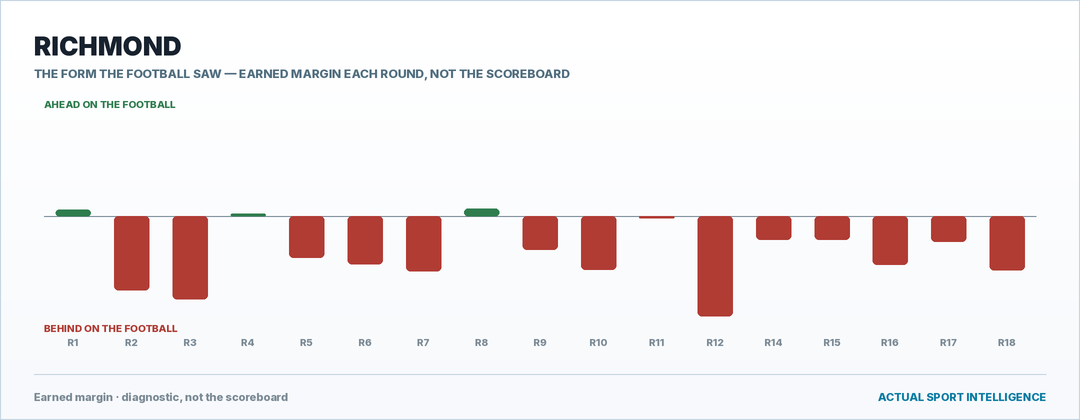
Watch Richmond across the last decade and the contest is not where the story lives. This year the engine's read on their season is blunt: their best work comes from moving the ball at will, and where they slip is control. That's a side that hurts you in transition, not one that wins the war at ground level.
The 2026 team is being beaten at the coalface — last in the league for contested ball — but that was true of some of their strongest sides too. The hard ball has rarely been the mechanism. When Richmond have been good, they've taken the ball they win and gone somewhere with it. When they slip, as now, it's control that goes, not the contest that was never theirs to begin with.
Here's the cleanest fact in the pack: since 2017, Richmond have won the contested-ball count in exactly one of ten seasons. In that same window they played finals five times. So four of their five finals campaigns were built while losing the hard ball.
That's not noise — that's a decade-long pattern pointing the opposite way to the popular story. If contested ball drove Richmond's success, you'd expect their good years to cluster with their strong contest years. They don't. The relationship, if anything, runs against the claim.
One caveat worth stating plainly: contested-ball ranking is one input, and this pack doesn't isolate every variable behind those finals runs. But the direction of the evidence is not ambiguous.
Set it against the benchmark. The 2018 side finished top of the ladder while ranking 15th of 18 at the contest, beaten by more than five contested possessions a game. That's not a team scraping by despite a weakness — that's a genuine winning standard achieved with the hard ball as a known deficit.
Even their best contest year, 2017, was only 12th in the league at +0.2 a game — barely above break-even — and that was the outlier that got them to a preliminary-final calibre finish (3rd).
So when 2026 arrives at -8.9 and 18th, the shock isn't that they're losing the contest. The shock is the scale. The direction is entirely in character for Richmond; the depth is what's new.
The temptation with a contested-ball narrative is to hang it on a bull midfielder who wins his own ball. The evidence here doesn't offer that individual — and that absence is the point. Richmond's better years weren't propped up by one man dominating the coalface.
What actually changed their story was collective: the ability to take ball won anywhere and convert territory. This season the engine flags the reverse problem — they leave points out on the ground, scoring fewer than the quality of their chances is worth. That's a finishing and connection issue, not a contest issue.
So the player who's really shaping 2026 isn't the one losing a clearance. It's whoever is meant to convert the good looks Richmond are already generating.
This is where outcome bias bites. Richmond are 2-15, so we reach for a villain, and the contest count — last in the league — is sitting right there looking guilty. But test it: in 2018 they lost the contest by more than five a game and finished first. Did anyone write that flag off as a hard-ball failure? Of course not.
Same mechanism, opposite scoreboard, completely different story. That tells you the contested-ball narrative is being generated by the ladder position, not by the football.
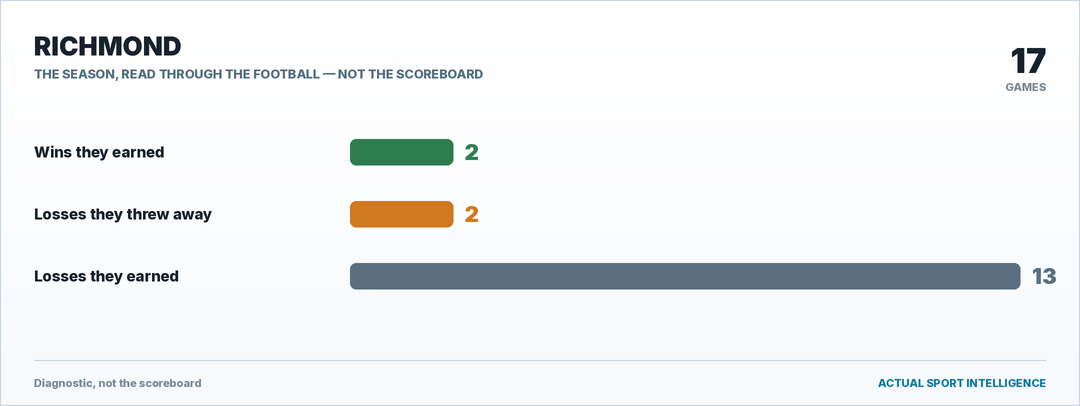
Richmond's own record splits the 2026 losses carefully: two they threw away, thirteen they earned. "Earned" losses are about not being good enough broadly — not a single contest column. The scoreboard is writing the headline, and the headline is reaching for the nearest number.
Let me push back on the room. There's a difference between losing the contest by a little and losing it by a lot. In 2018, Richmond were -5.2 and elite everywhere else, so the deficit was survivable. In 2026 they're at -8.9 — the worst in the league, worst of their decade. At some point a weakness stops being a quirk and becomes a wound.
If you can't win enough of your own ball, you can't reliably launch the ball movement Richmond depend on. So maybe this year the contest isn't irrelevant — maybe it's finally deep enough to strangle the very strength that used to carry them.
The room's ten-year pattern is real. But a pattern built on manageable deficits doesn't automatically hold when the deficit doubles.
Strip it back and two things are true at once. First, the claim as stated — that Richmond's success is built on winning the contested ball — is not supported by their own decade. Four of five finals runs, and a minor premiership, came while being beaten at the coalface. The hard ball was never the engine.
Second, 2026 is not a normal Richmond year. The contest deficit isn't just present, it's the deepest they've ever recorded, and it sits alongside a side that can't convert the chances it creates. That's why the Counter-Case matters: the pattern says contest never drove success, but the scale this year is a new variable.
So the headline shouldn't be "Richmond win when they win the contest." It should be "Richmond have never won that way — and now they're testing whether they can lose it this badly and survive."
What the room agrees on
The room agrees the headline claim doesn't survive Richmond's own history. Across ten seasons they won the contested-ball count once, yet reached finals five times — including a 2018 side that topped the ladder while being beaten by more than five contested possessions a game. Their identity is moving the ball, not muscling it. The contested-ball story, most seats agree, is being pulled from the ladder position rather than the tape.
Where the room still has tension
The genuine tension is scale. The Counter-Case argues that a deficit of -8.9 a game — the worst in the league and the worst of Richmond's decade — is a different animal from the manageable -5.2 of their premiership era. A weakness you could carry at five may become a wound at nine, because you can't launch your trademark ball movement off ball you never win. The room can't fully settle whether 2026's contest loss is the same old irrelevance or a new threshold that finally bites.
What the evidence carries
What the evidence carries cleanly: Richmond's success has not, historically, been built on winning the contested ball. That's not opinion — it's ten years pointing one way, with a flag-year proof at the centre. Anyone telling you 2026's contest count explains their season is reaching for the guilty-looking number.
What the evidence can't settle: whether this year's deficit is so extreme that the old rule no longer holds. The pattern was built on smaller gaps and strength elsewhere; this year the gap is bigger and the conversion is worse. That's a live question the pack can't close.
So hold both. The contested-ball narrative is a myth about how Richmond win, and a possible clue about how this particular team is breaking. Which one you weigh more heavily — the decade or the extreme — the rest is yours to weigh.
Why it matters — It's a clean case study in how a losing scoreboard manufactures a cause-and-effect story the history flatly denies.