Fremantle Move The Ball At Will Again — And The Scoreboard Finally Told The Truth
Fremantle beat Sydney by 38 and the football had them by about 39. So this one's simple, right? The room isn't so sure — because the way Freo win still hides the one thing that could undo them.
Round 18, 2026. Fremantle 111 defeated Sydney 73 at home, a result that pushed the Dockers to 15-2. The engine reads it as a True Win — Earned, and the margin on the board almost exactly matched the margin in the football. But underneath a clean result sits Fremantle's season-long signature: brilliant with ball in hand, less certain when the game demands control.
This was Fremantle playing their song. They won the contested ball at roughly 55 per cent and tilted territory their way on close to 58 per cent of entries, which is the exact profile of a side that dictates terms rather than survives them. When the football says a team 'moved the ball at will', this is the picture: win it at the source, then run it into the right end of the ground.
The wrinkle is the tackle count. Sydney laid far more tackles than Fremantle did, and that's usually the fingerprint of the team chasing — you tackle more because the other mob has the footy more often. So Sydney's pressure numbers look busy, but busy in defence. Freo dictated; Sydney reacted.
The one honest note: both sides left goals out there. Fremantle's looks were worth more than they cashed. On another day that's a bigger scoreline.
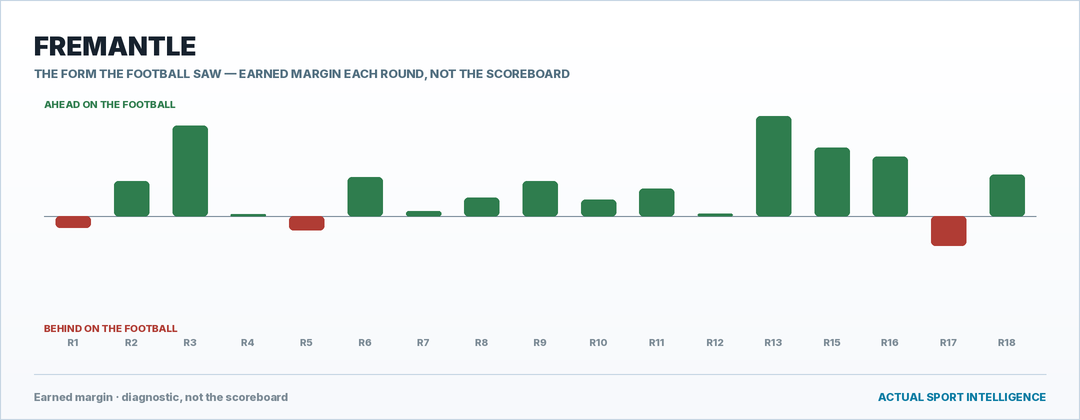
Start with the cleanest fact: the scoreboard read Fremantle by 38, the underlying football had them by about 39. When the margin you see and the margin the game earned land almost on top of each other, you're not arguing with noise — the result reflected the play.
The honest caveat is finishing. Fremantle's chances were worth about 126 and they managed 111; Sydney's were worth roughly 87 for 73. Both sides were wasteful in front of goal, so the 38-point gap slightly understates how the game actually flowed. It doesn't overstate it — which matters more.
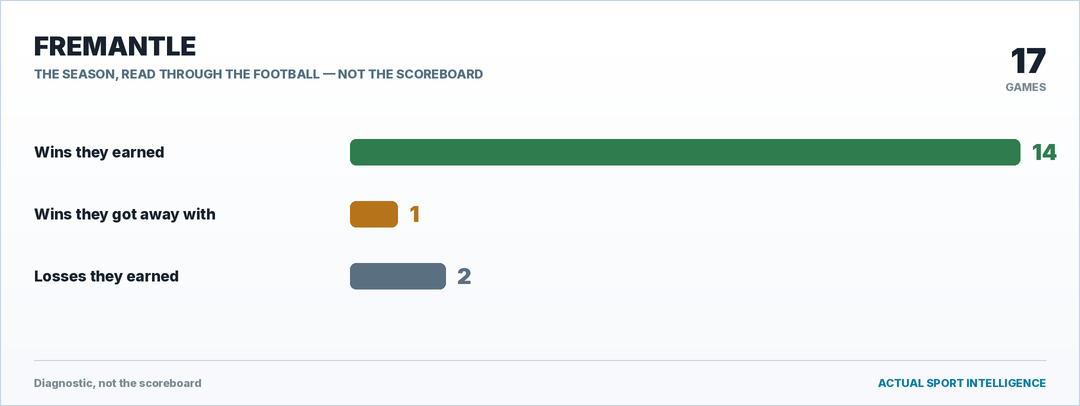
And this isn't one loud night in isolation. Across 17 games, the football's own tally is 14 wins earned, one got away with, two losses earned. That's a large, consistent sample. The confidence here is real.
Plenty of good seasons look shiny until you check the receipts. Fremantle's don't shrink under inspection. Of their 17 games, the football grades 14 as wins they truly earned and only one as a win they got away with. Most contenders carry a handful of fortunate results on the ledger by this point of a season. Fremantle carry one.
Against a finals standard, that's the number that travels. Sides win 15 of 17 in soft draws and flattering bounces all the time; sides win 14 of them on merit far less often. This is closer to the profile of a team building something than a team riding a hot run.
So no, this isn't recency talking. Beating Sydney by 38 is a good night. Doing it as the 15th earned-standard performance in a season is the part that belongs in the archive.
The three names the football flags as most decisive for Fremantle — Shai Bolton, Josh Treacy and Jordan Clark — line up neatly with how the win was built. Clark's drive and Bolton's damage feed the ball-movement game; Treacy gives it a target when it lands inside 50. These aren't headline reputations doing headline things; they're the players who actually moved the result.
For Sydney, Chad Warner and Nick Blakey were the best of them, and that's the trap in a beaten side. Their output was real, but it was output in a losing structure — the effort that keeps a team in touch rather than the influence that swings a game.
The read: Fremantle's best matched their method, Sydney's best fought the tide. Same effort category, very different effect on the scoreboard.
This is the test that catches most match reports: would we tell this story if Sydney had nicked it? Here, the answer holds. The margin on the board (38) and the margin in the football (about 39) are almost identical, so the scoreboard isn't inflating a story the play didn't support.
If anything, the outcome slightly flatters Sydney, not Fremantle. Freo's looks were worth about 126 — a fair bit more than the 111 they posted. Had they finished cleanly, this is a heavier night. So the risk of outcome bias runs the opposite way to usual: the result is real, and the underlying play was arguably a touch better than the result.
That's the mark of a clean win. You don't need the scoreboard to defend the performance, because the performance defends itself.
Here's what should trouble the confident reader. Fremantle's own season profile says their best work is moving the ball at will, and where they slip is control — grinding, low-scoring, arm-wrestle football. This win came in the first mode, not the second. It tells us Freo are elite when the game flows their way. It tells us almost nothing new about the day someone strangles it.
Look again at the tackle count: Sydney applied more tackle pressure than Fremantle did. On this night it read as chasing. In a tighter, uglier game — the kind September specialises in — that same pressure is how good sides drag Fremantle into their weakness.
And both teams were wasteful in front of goal. Against sharper opposition, leaving 15 points of chances unconverted isn't a footnote. This performance is genuine. But it's a strength being confirmed, not a doubt being answered.
Strip it back and this game is a beautifully clear expression of who Fremantle are in 2026: win the contest, own territory, move the ball, score. The eye, the scoreboard and the numbers all agree, and the season ledger — 14 earned wins in 17 — says this is the norm, not the highlight.
But the sharpest reads in the room aren't fighting over whether Fremantle are good. They're circling the same tension: this was a win in Fremantle's preferred style, against a side that reacted rather than dictated. The contradiction isn't in the result — it's in what the result can and can't teach us.
So the headline shouldn't be 'Freo too good'. It should be: Fremantle again did the thing they're brilliant at, and the one thing that might undo them — a game played on someone else's terms — wasn't on the table tonight. Strength, confirmed. Question, parked.
What the room agrees on
Every seat lands on the same core: this was a clean, earned win. Fremantle won the contest and territory, moved the ball the way they do all year, and the 38-point margin sat almost perfectly on top of the football's own read of about 39. The season context reinforces it — 15 wins from 17, with 14 of them graded as genuinely earned, which is a contender's ledger, not a lucky one. Nobody in the room is arguing Fremantle got away with this.
Where the room still has tension
The tension is about what the win teaches. The football, evidence, baseline and scoreboard seats see confirmation of a very good side. The counter-case and story seats push back: this was Fremantle winning in their favourite mode — ball movement, flow, front-foot football — against an opponent that spent the night chasing, shown by Sydney laying far more tackles. Fremantle's own season identity flags control, the grinding arm-wrestle, as where they slip. This game never dragged them there. So the room splits not on quality, but on how much a stylish win in your best conditions can tell you about your worst.
What the evidence carries
What survives the whole review is straightforward. Fremantle were the better side by a margin the football fully backs, driven by Bolton, Treacy and Clark doing the exact jobs their game plan asks for. The result is real, the season behind it is real, and if anything the scoreboard slightly understates how well they played — their chances were worth more than they cashed.
What the evidence can't carry is the finals question underneath it. This was a win on Fremantle's terms. The one signal that points to a soft spot — control in a strangled game — wasn't tested, because Sydney couldn't impose that kind of contest. A 38-point win confirms a strength; it doesn't answer a doubt that only a different type of game can pose.
So the picture is a side playing to a genuinely high, repeatable standard, with one honest gap in what tonight could reveal. Whether that gap matters as much as the counter-case fears, or whether a team this good simply won't be dragged into it — the rest is yours to weigh.
Why it matters — It tells you Fremantle are the real thing while being honest that their one open question is still open — the difference between a good season and a September answer.