Collingwood's Engine Isn't the Hard Ball — And the Record Says So
They sit 17th of 18 at the contest and still hold a winning half-year. The question is whether the Pies' success runs through the coalface — or somewhere else entirely.
Collingwood are 9-7-1 through 17 games in 2026 while getting beaten at the contested ball almost every week. The claim that their success is 'built' on winning the hard ball is one of footy's stickier assumptions. We put it in front of the room to see what the evidence actually carries — and where the idea comes from in the first place.
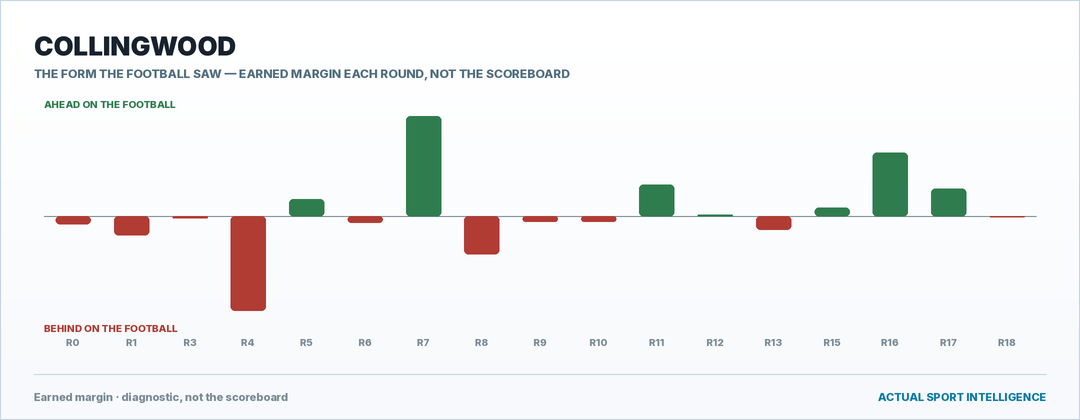
Watch Collingwood this year and the contest is not where the game turns for them. They're being beaten at the hard ball most weeks, giving up roughly nine contested wins a game. If success were built there, you'd expect a struggling side. They're not.
What actually shows up is transition. Their best work comes from moving the ball at will — winning ground, linking through the corridor, hurting sides on the way to goal rather than at the bottom of the pack. Where they wobble is control: holding territory once they've got it.
So the mechanism isn't 'win the clearance, win the game'. It's 'lose enough of the contest to stay honest, then punish you in transition'. That's a different side to the one the headline describes.
Let's be precise. This season Collingwood average 120 contested possessions to 129 — 17th of 18, about eight and a half down a game. Alongside that sits a 9-7-1 record. Two numbers moving against each other is not the picture of a side 'built' on the hard ball.
Zoom out and it holds. Across their last ten seasons they've won the contested count in only five, yet played finals in eight. The overlap between hard-ball dominance and success is partial at best.
The honest limit: contested ball is one input, and a full season is a solid sample but not a controlled experiment. I can say the claim has outrun the evidence. I can't say the contest is irrelevant — only that it clearly isn't the load-bearing wall.
The instinct that contested ball equals success is old and mostly sound league-wide. But held against Collingwood's own archive, this season isn't an aberration — it's consistent with how they've often gone.
The clearest exhibit is 2022: they finished fourth while ranking 17th of 18 at the contest, beaten by nearly ten possessions a game. Their strongest contest year, 2018 — plus nine and a half a game, second in the league — returned a third-placed finish. Good, but not obviously better.
So against their own baseline, a top-half record built without the hard ball isn't rare. It's closer to the norm. What feels unusual is only unusual if you assume the standard model applies to this club. Their history says it doesn't cleanly.
If the hard-ball narrative were true, you'd expect the contest winners to be Collingwood's headline actors. The evidence points elsewhere. Their edge lives in ball movement and in finishing that has roughly matched the quality of chances they've created — meaning the players who matter most are the ones who use it and convert it, not the ones who merely dig it out.
That reframes who's carrying the season. The contest workers are doing a containment job — losing the count but keeping it close enough that transition can do the damage. Necessary, but not the leading role.
Without individual splits I won't name names. But the shape is clear: the players 'built' into this success are movers and scorers, and the hard-ball brigade is the supporting cast the headline keeps promoting.
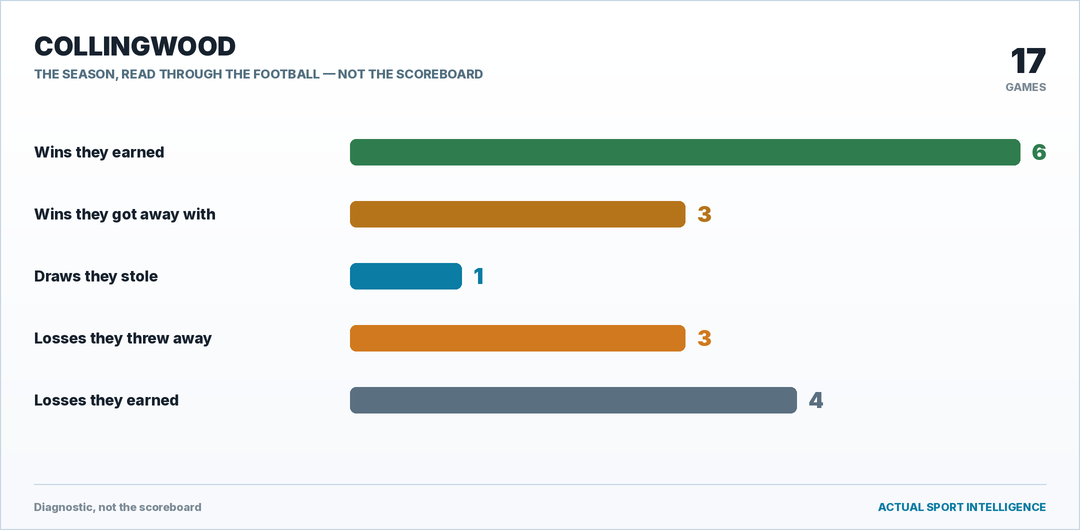
This is where outcome bias bites. Collingwood's nine wins aren't all the same. Six they earned, three they got away with, and there's a stolen draw in there too — against three losses they threw away and four they earned honestly.
Strip out the three fortunate wins and the stolen point, and the record looks a lot more like a side treading water than one riding a winning formula. Now ask: if those tight ones had tipped the other way, would anyone be crediting the contested ball for 'success'? They wouldn't — because the contest numbers would be identical either way. Seventeenth of 18 doesn't move.
That's the tell. The contested-ball read is stapled to the scoreboard, not to the evidence. The hard-ball count says the same thing regardless of who won the close ones.
Let me push back on the room. Total contested possessions is a blunt tool. A side can be beaten on volume while winning the contests that actually decide territory and scores — clearances at the right end, the ball-ups near their own goal, the fifty-fifty that starts a chain. Minus eight and a half a game could hide a side winning the important ones and losing junk in dead zones.
And 'built on' is slippery. If your transition game only works because your midfield loses the contest respectably rather than catastrophically, then the hard ball is quietly holding the whole thing up — just not in the column everyone quotes.
The evidence here doesn't split contest by location or leverage. Until it does, declaring the coalface irrelevant is its own overclaim.
Beneath the topic sits a contradiction. The league gospel says you win the hard ball to win games. Collingwood keep winning — often enough to play finals in eight of ten years — while frequently losing it. This season crystallises it: bottom-of-the-league contest, winning-half record.
So what should the headline actually mean? Not that contested ball doesn't matter, but that for this club it isn't the foundation. The foundation is ball movement — the ability to hurt sides in transition even from a losing base at the coalface. The hard ball is a floor they're willing to concede, not a platform they build on.
The Brigadier's caution keeps it honest: we can't yet see which contests they win. But the through-line is clear — Collingwood have made losing the count survivable, and turned somewhere else into their edge.
What the room agrees on
Every seat lands on the same core: the raw numbers point the wrong way for the 'built on the hard ball' claim. They're 17th of 18 at the contest, down about eight and a half a game, and still 9-7-1. Their own history reinforces it — finals in eight of ten seasons, the contest won in only five; a fourth-placed 2022 built while ranked 17th at the coalface. The engine reads their edge as ball movement and finishing that matches their chances, not clearance dominance.
Where the room still has tension
The genuine tension is whether total contested count is even the right measuring stick. The counter-case argues a side can lose the volume while winning the contests that decide territory and scores — and this evidence can't split the count by location or leverage. The scoreboard read adds another wrinkle: three fortunate wins and a stolen draw mean 'success' itself is doing some heavy lifting. So the room agrees the headline claim is weak, but not on how much the hard ball is quietly propping things up underneath.
What the evidence carries
What survives the whole review is this: the simple version — Collingwood win because they win the contested ball — does not hold. The count and the record move in opposite directions this year, and their own decade says the same. Where they do their best work is moving the ball, not digging it out.
What the evidence can't yet carry is the deeper claim. It can't tell you which contests they win, or whether a 'respectable loss' at the coalface is secretly the thing that lets their transition game breathe. That's a real gap, not a technicality.
So the shape is clear even if the last brick isn't: this is a side that has made losing the hard-ball count survivable, and found its edge elsewhere. Whether you call that 'success despite the contest' or 'success built on a quiet contest floor' — the rest is yours to weigh.
Why it matters — How you read this decides whether you'd 'fix' Collingwood's contest or protect the game that's actually winning them matches.