Adelaide's 11-6: the nine wins they actually earned, and the question no one's answered yet
Nine earned wins is a serious number. Whether those wins came against genuine resistance is the part the ledger can't tell us — so the room takes both sides and hands the call back.
Adelaide sit 11-6 through 17 rounds of 2026 and the 'genuine flag threat vs flat-track bullies' argument has hardened into a slanging match. We put the topic in front of the seven seats. The evidence pack carries Adelaide's own game-by-game breakdown and Port Adelaide's as a nearby yardstick — but no opponent-strength data, which is exactly where the fight lives.
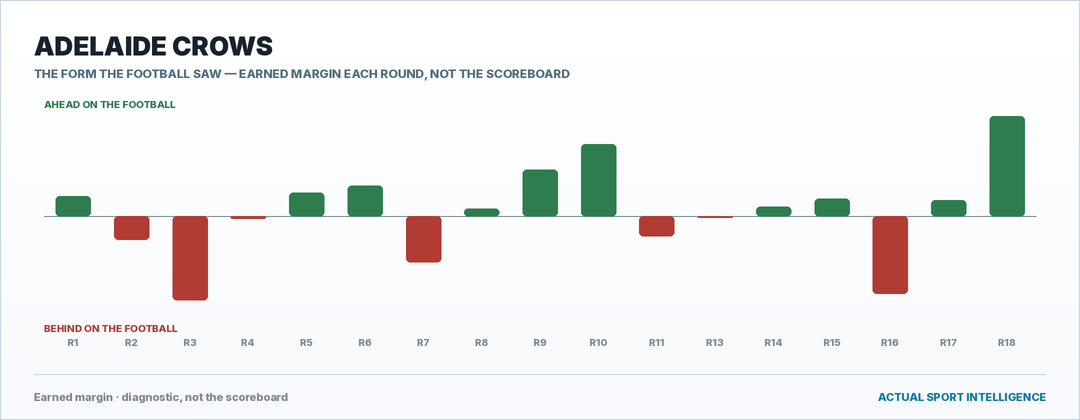
Watch how Adelaide play and the identity is unmistakable: they move the ball at will. When the corridor opens and they can run and carry, they look like one of the best-shaped attacking sides in the competition — the ball goes coast to coast and lands in dangerous spots.
The wobble is in control. When a game becomes a slog — stoppage after stoppage, territory choked, no space to move — Adelaide slip. That's not a fatal flaw, but it's the seam a good opponent pulls at. A flag threat has to win the ugly ones too, not just the open ones.
So what the football showed is a genuinely dangerous attacking machine with a known pressure point. Both parts are true at once.
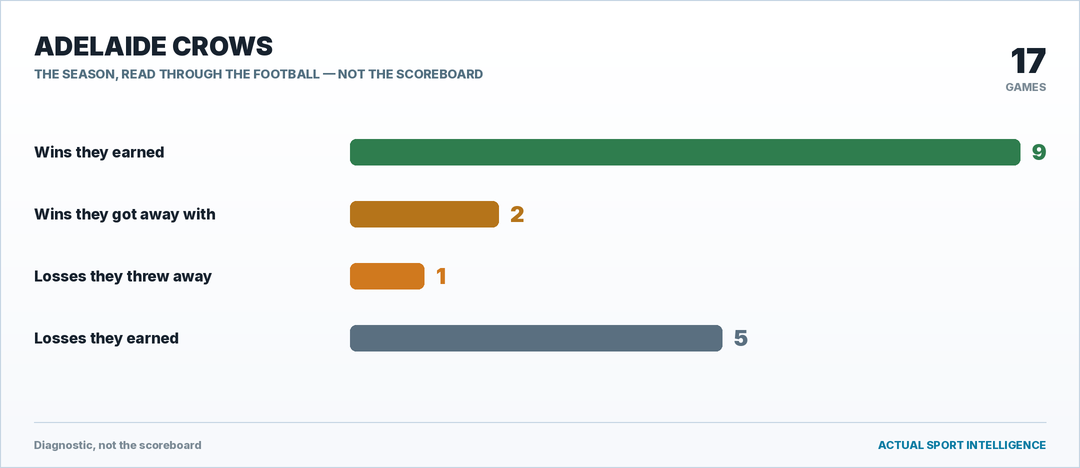
The cleanest number here is the quality of the 11-6. The football's read splits it into nine wins they genuinely earned, two they got away with, one loss they threw away and five losses they earned. Nine earned wins from 17 is a real signal — that's not a record propped up by luck.
But here's the honest limit. The pack tells us how well Adelaide played, not who they played. There is no opponent-strength data in front of me. So the specific 'flat-track bullies' charge — that the wins came against weak sides — cannot be confirmed or denied from what we hold.
That's the discipline. The evidence carries 'this is a good side'. It does not carry 'this is a padded record'. Anyone claiming the second is reaching past the numbers.
Set 11-6 against the ordinary run of a season and it's a clearly above-average year — a side well inside the contending group rather than making up numbers. The nine genuinely earned wins is the figure that lifts it above 'nice record, soft underneath'.
The useful contrast is right next door. Port Adelaide sit 6-11 with only three earned wins and four losses they threw away — a side beating itself. Adelaide have one thrown-away loss. That gap in self-inflicted damage is the difference between a settled contender and a scrambling season.
What the archive can't tell me yet is whether this profile is a finals-winning one, because the standard that matters — beating quality under pressure — needs opponent context this pack doesn't hold.
There's no individual in this pack, and that's actually the point. Adelaide's edge is collective: a way of moving the ball that turns half-chances into scores. The signal that they're clinical — converting better than the raw quality of their chances suggests — tells you the finishing is doing quiet, repeatable work.
Contrast that with Port, who leave points out on the ground, scoring less than their chances are worth. Same city, opposite trait. Adelaide bank what they create; Port spill it. That conversion habit is the hidden contributor doing more than any one name on a teamsheet.
So if you're hunting the player carrying the headline, look instead at the machine. The 'statement' isn't one star — it's a system that keeps its scoreboard honest.
This is where outcome bias usually distorts everything, so test it. If Adelaide were 6-11 like Port, we'd be writing them off. So does the 11-6 flatter them?
The answer here is mostly no, and that's unusual. The football's own read already discounts the luck: only two of the eleven wins were ones they got away with. Peel those two off and you're still left with nine wins they earned on merit. The record isn't a mirage the scoreboard painted — it's largely backed by performance.
Where the scoreboard could still be fooling us is the opposite direction from the usual: the win column might be hiding softness of opposition rather than softness of Adelaide. The result looks earned; whether it was earned against much resistance is the bit the scoreboard can't confess.
Here's what should worry the believers. Adelaide's whole game is built on moving the ball at will, and their acknowledged slip is control. Finals football is a control contest — congestion, pressure, the corridor slammed shut. If a side's strength is space and its weakness is the grind, you have a profile that can be systematically shut down by the right opponent.
And the nine earned wins? Impressive, but nobody in this pack tells us how many came against sides that could impose that grind. A record can be genuinely earned and still be earned in conditions that won't exist in September. Those two things aren't a contradiction.
So the counter-case isn't 'they're frauds'. It's sharper: they're a real side with an unproven answer to the exact type of game that decides flags.
Strip it back and the 'statement vs flat-track bullies' framing is a false choice. The evidence carries both a genuinely good side and a genuinely open question, and pretending it's only one is where the noise comes from.
What's solid: nine earned wins, only one loss thrown away, a clinical scoreboard, and a clear identity built on ball movement. That's not a con. Next to Port's self-defeating 6-11, it's the profile of a proper contender.
The hidden contradiction is that the same trait making them dangerous — thriving in space — is the one that hasn't been tested in the grind that decides flags, and against opposition we can't grade from here. The headline shouldn't read 'flag threat' or 'flat-track bullies'. It should read: a real side, with a real record, and one honest gap between them and the answer everyone wants.
What the room agrees on
The room lands together on the core: this is a genuinely good side, not a lucky one. Nine of the eleven wins were earned on merit, only two were got away with, and just one loss was thrown away — a cleaner profile than Port Adelaide's self-defeating 6-11, where four losses were thrown away and only three wins earned. Adelaide's identity is real too: they move the ball at will and they're clinical, converting better than their chances deserve. Nobody at the table calls the record a fraud.
Where the room still has tension
The tension — and it's the whole point — is what the record proves. The evidence can grade how well Adelaide played but not who they played; there's no opponent-strength data here. So the 'flat-track bullies' charge can't be confirmed or dismissed. Worse for the believers, Marsh's counter-case bites: their strength is open space, their slip is control, and control is what finals are made of. A real record built in the wrong conditions is still a real record — and still an open question.
What the evidence carries
So here's where it settles without settling. The scoreboard isn't lying: strip the two lucky wins and nine earned ones remain, which is more than most contenders can say. The attacking system and the finishing are repeatable, not flukes.
But two things the evidence simply does not hold are the two things the argument turns on — the quality of the opposition beaten, and whether this side can win the grinding, low-space games that decide September. On both, the honest answer is: not in this pack.
That leaves you with a good side carrying a strong, largely earned record and one unproven gap. Whether you read that as a flag threat or a record waiting to be tested says as much about your appetite for risk as it does about Adelaide. The evidence takes you this far and stops here honestly — the rest is yours to weigh.
Why it matters — It separates what Adelaide have actually banked from what fans are projecting onto them — and shows exactly where proof runs out.