West Coast and the hard ball: the story the count keeps telling
The idea that the Eagles rise and fall on the contested ball is neat, popular — and mostly not what a decade of their own numbers shows.
West Coast sit 4-13 in 2026 and rank near the bottom of the league at the contested ball. It's tempting to draw a straight line: lose the hard ball, lose the season. The room went looking for whether the Eagles' good years were ever actually built on winning the contest — and whether the current slide really rests there.
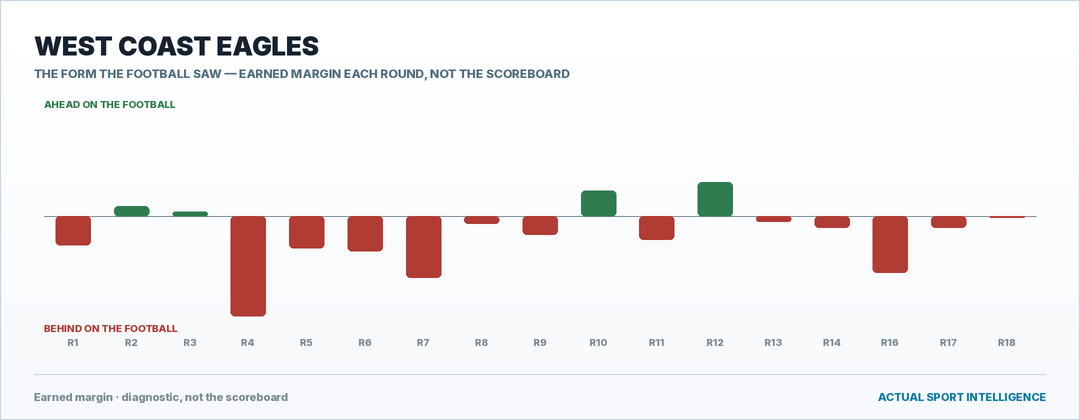
Watch West Coast this year and the picture is clear enough. Their season identity is a group that moves the ball at will when it gets going — the ball-use is the strength. Where they come undone is the disrupt end: stopping the opposition's flow, applying the squeeze the other way.
The contest itself? They're losing it, sitting 16th of 18 and beaten by seven a game. But the football tells you that's a symptom, not the engine. A side that scores off good ball movement but can't disrupt is leaking games through transition and defensive shape, not purely through who wins the first hard ball.
The hard ball matters — it always does — but on the eye test West Coast's story lives further up the ground, in what they do once they have it and what they fail to do when they don't.
Here's the number that anchors everything: since 2017, West Coast have won the contested-ball count in just one of their last ten seasons. In that same stretch they played finals four times. So three of their four finals seasons happened while they were being beaten at the contest.
That's not noise from one odd year. It's a decade-long pattern, and it points the opposite way to the headline. Ten seasons is a genuine sample — enough to say with real confidence that contested-ball dominance has not been the precondition for this club playing finals.
What I can't tell you from this pack is the causal mechanism behind the good years — what actually drove those finals runs. The evidence rules the contest out as the foundation; it doesn't hand us the replacement.
Set it against the club's own archive and the pattern stops looking strange. In 2019 West Coast finished fifth while ranking 17th of 18 at the contest, beaten by more than eight a game. That's a top-six season built while being thumped at the coalface — and it's the clearest tell in the file.
Compare the extremes. Their best contest year was 2018: plus 1.4 a game, seventh in the league, and they finished second. Their worst was 2023: minus 18.2 a game, dead last, 18th on the ladder. So the contest and the ladder do line up at the edges — but in the messy middle, like 2019, they simply don't.
Against the winning standard, the honest read is that this club has repeatedly cleared the finals bar without owning the hard ball. That's not fresh — it's a decade-old habit.
When a side gets pinned to a single number — contested possessions — the players doing the real work often go missing from the story. West Coast's identity this year is built on moving the ball well, which means the value sits with the users and the runners, not just the inside grunt.
The flip side is where the story genuinely turns: the disrupt end. That's a collective failing more than a single-position one — the pressure, the defensive connection, the ability to stop the opposition's transition. Those are the roles quietly deciding games, and they don't show up in a contested-ball tally.
So the count is the headline actor; the ball-movement and the missing defensive squeeze are the ones actually changing outcomes. Judge the group on those, not on who won the most contested touches.
This is where outcome bias bites. West Coast are 4-13 and losing the contest, so the story writes itself: they're bad because they lose the hard ball. But run the test — would we believe that if the scoreboard had gone the other way?
We already know the answer, because it did. In 2019 the exact same contested-ball weakness — 17th of 18, beaten by more than eight a game — sat underneath a fifth-placed finish. The number didn't change; the result did, and with it the narrative would have flipped completely.
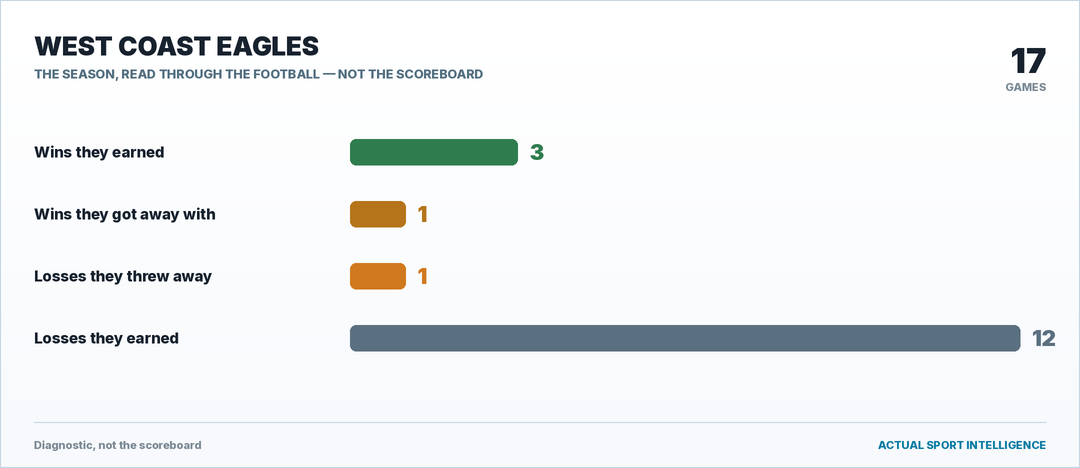
That's the tell. The contested-ball reading is being back-fitted to the current result. And note the club's own game-by-game record this year: three wins they earned, one they got away with, one loss they threw away, twelve losses they earned. That's a side genuinely beaten in most games — but not because of a number that also sat under a finals campaign.
Let me push back hard, because the room is leaning comfortable. Look at the bookends and the contested ball looks like it matters plenty. Their best contest year, 2018, brought a second-placed finish. Their worst, 2023, brought minus 18.2 a game and a wooden spoon, 18th of 18. That's not coincidence — that's the hard ball and the ladder moving together.
And this season fits that grim end: 16th at the contest, minus seven a game, 4-13. You can argue 2019 was the exception that proves nothing repeats it. One anomalous season inside a decade doesn't dismantle a relationship visible at both extremes.
The honest challenge: maybe the contest sets the floor and the ceiling, and 2019 was a side that briefly out-ran its own foundations. If that's true, the current collapse is exactly what losing the hard ball looks like.
Strip it back and there are two arguments fighting. One says the contest is decorative — West Coast made finals four times, won the count once, and their identity is ball movement. The other, the counter-case, says the extremes don't lie: dominate the contest and you finish second, lose it badly and you get the spoon.
The resolution is in the middle. The contest may shape the outer edges of a season, but it has clearly never been the foundation of West Coast's best years — 2019 proves a finals ceiling can be reached while being beaten at the coalface. The headline 'their success is built on the contested ball' simply doesn't survive their own decade.
So the true story isn't about the hard ball at all. It's about a side that lives on moving the ball and dies on failing to disrupt — and a public reading that reaches for the contested-ball count because it's simple, visible, and fits a 4-13 record.
What the room agrees on
Every seat accepts the core fact: since 2017 West Coast have won the contested-ball count in just one of ten seasons yet played finals in four, with 2019 the standout — fifth on the ladder while ranked 17th of 18 at the contest. The room agrees the club's identity is built on moving the ball well and that its clearest weakness this year is the disrupt end, not simply the hard ball. On the direct topic, the room leans firmly against the headline: this success was not built on winning the contest.
Where the room still has tension
The tension is about how much the contest still matters. The counter-case makes a real point — at the extremes, 2018's contest edge and second-place finish, 2023's minus-18.2 and the wooden spoon, the hard ball and the ladder move together, and this 4-13 season sits in that same bottom bracket. Is the contest the floor and ceiling that West Coast occasionally out-run, or a number that gets back-fitted to whatever the scoreboard says? The room can't fully settle that from this pack.
What the evidence carries
What survives all seven seats is straightforward: the claim that West Coast's success is built on winning the contested ball does not hold against their own ten years. Three of four finals seasons came while being beaten at the contest, and 2019 shows a top-six side doing it emphatically. The foundation of the good years lived elsewhere — in ball movement.
What the evidence can't carry is a clean answer on how much the contest still shapes the edges. The extremes genuinely track the ladder, and this season's deficit sits at the wrong end. Whether that's cause or symptom, the pack doesn't resolve — the mechanism behind the good years isn't in here.
So you're left with a club whose story is ball-use and disrupt, not hard-ball dominance, and a current slide that's easy to hang on a single visible number. Whether you weight the decade-long pattern or the extreme-year correlation is the call — and the rest is yours to weigh.
Why it matters — Misreading where a club's success actually comes from leads to fixing the wrong thing.