St Kilda Own The Coalface. So Why Are They 8-9?
The Saints win the contested ball better than anyone in the competition this year — first of 18. Yet they sit mid-table. THE ACTUAL STORY on whether the contest is really where their season lives.
St Kilda are 8-9 from 17 and lead the league at the contest, averaging 129 contested possessions to their opponents' 123 — the best margin in the competition. The easy story is that grunt is their engine. But the ladder position, their season identity and a decade of history all pull at that idea. So is success really built at the coalface?
Watch St Kilda and the contest looks like the foundation — they beat everyone to the coalface this year, the best contested-ball margin in the competition. That's real. Bodies over the ball, first hands, clearance grunt: it's there most weeks.
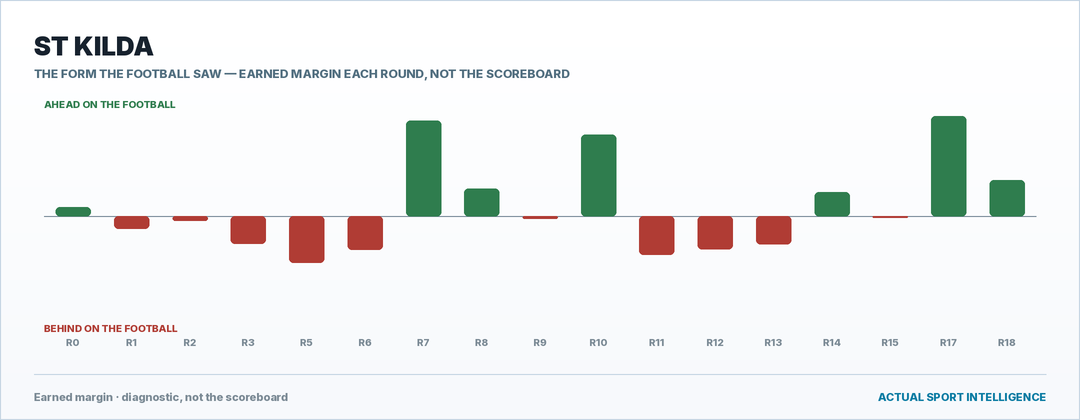
But the football's own read of this side says something different. Where they do their best work is moving the ball at will — clean transition, ball movement through the corridor, hurting sides on the run. Where they slip is disrupt: stopping the opposition's ball movement coming back the other way.
So the contest is a strength they win, not necessarily the lever that wins them games. They gather the hard ball, then the story is decided by what happens next — how far they can carry it and whether they can stop the return. The coalface fills the tank. It isn't the whole engine.
Two things are firmly true. St Kilda are first of 18 at the contest this year, and they're 8-9. Both are facts. The claim that connects them — that the contest is driving the success — is where the evidence thins out.
Here's the tension. Their single best contested-ball year in a decade is this one, and it has them mid-table. If winning the hard ball reliably won games, the best coalface season shouldn't be an average ladder season. That's not proof of nothing; it's proof the link is looser than the headline wants.
One season is also a small window, and 8-9 is close to even. I'd resist any confident causal statement in either direction. What survives is narrow but honest: they win the contest clearly, and the scoreboard hasn't followed at the same rate.
The instinct is to treat a league-leading contest number as a special season. The archive says otherwise for St Kilda. They've won the contested-ball count in seven of their last ten seasons. Owning the hard ball is their default setting, not a fresh identity.
And here's the part that reframes everything: across those seasons, they've played finals in only two. So the club has a long habit of winning the coalface and still watching September from home. The contest is the floor of who they are, not the ceiling of what they achieve.
Compare the extremes. Their weakest contest year in the window landed them near the bottom. Their strongest — this one — has them tenth. If the contest set the standard, those two shouldn't sit so close on the ladder.
The headline hands the credit to the inside brigade — the clearance and hard-ball winners who make that league-best contest number. They earn it. But the player truth is that their work is being handed on, not cashed in.
The season read is blunt on this: St Kilda leave points out on the ground. They score fewer than the quality of their chances is worth. That's not a coalface failing — the ball is being won. It's a finishing and connection failing, which lands on the forwards and the ball-users, not the ball-winners.
So the genuine story-changers are hiding one line down the stat sheet. The contest players are carrying the headline. The players who'd actually shift St Kilda's season are the ones meant to turn all that hard ball into a scoreboard — and right now they're the ones going missing.
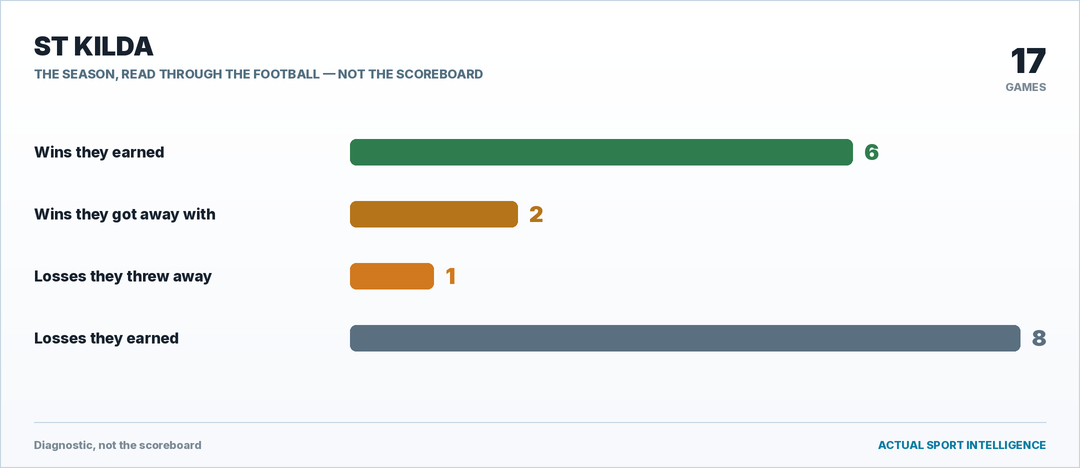
This is where outcome bias creeps in. At 8-9, the 'built on the contest' story feels balanced and reasonable. But the football's honest ledger of those 17 games tells you the record is soft in both directions — six wins they genuinely earned, but two they got away with, and one they threw away.
Strip out the two fortunate wins and the story shifts hard. Suddenly the league-best contest side is well under .500, and the same coalface dominance reads as damning: all that hard ball, so little to show. The number doesn't change. Only the scoreboard's mood does.
That's the trap. We're crediting the contest partly because the record looks respectable. But the record is flattered. Judge the contest on what it produced, not on where the wins happened to land.
Let me put the other case properly. Everything the room is doing to downgrade the contest could be backwards. St Kilda win the hard ball first of 18, and everything else — the ball movement, the chances, even the games they get away with — flows from having the ball in hand more often at the source. Take that away and there's no transition to admire and no chances to waste.
History can be read the other way too. In their weakest contest year they finished near the bottom. Lose the coalface and the floor drops out. The contest may not guarantee finals, but it might be the thing keeping them off the bottom.
And 2021 cuts against the room: a year they lost the contest slightly, they still finished tenth — so maybe the ladder isn't as chained to the coalface as everyone here assumes, in either direction.
Put the six reads together and a cleaner shape appears. Nobody disputes St Kilda win the contested ball — they lead the league, and they've done it for most of a decade. The argument isn't about the coalface. It's about what happens after.
The central contradiction is this: their single best contest season in ten years is a mid-table season. The strength is maxed out and the ladder hasn't moved. That points the finger away from grunt and toward everything downstream — the ball movement they're good at, the disrupt they're not, and the scoreboard they keep short-changing.
So the honest headline isn't 'built on the contest'. It's 'built on the contest, stuck after it'. They win the fight at the bottom of the ground more clearly than almost anyone. The question their season actually asks is why that keeps buying so little.
What the room agrees on
Every seat accepts the base fact: St Kilda win the contested ball, and win it convincingly — first of 18 this season, and in seven of their last ten years. That's not in dispute. Where the room lines up is that this dominance is their normal state, not a new edge, and that it isn't translating into the ladder at the rate the headline assumes. A league-best contest season sitting at 8-9 and around tenth is the fact that keeps reappearing at every seat.
Where the room still has tension
The live tension is direction of cause. Most of the room reads the contest as a strength that isn't paying — the real story sits downstream in ball use, disrupt and finishing, where St Kilda leave points out on the ground. The counter-case pushes back hard: strip the contest away and there's no ball to move and no chances to waste, so the coalface may be the platform holding the whole thing up. That argument isn't token — the year they lost the contest, they finished near the bottom. The room can't fully settle whether the contest is the engine or just the fuel tank.
What the evidence carries
What survives the whole review is this. St Kilda win the contested ball better than almost anyone, and they've done it for years — so 'success built on the contest' gets the strength right and the conclusion wrong. The coalface is real. The success is the shakier half of the sentence, at 8-9 with a record flattered by two wins they got away with.
The evidence carries that they dominate the contest and that the scoreboard hasn't followed. It cannot cleanly carry that the contest is causing whatever success there is — because their best-ever contest season is a mid-table one, and history shows coalface dominance and finals rarely arriving together for this club.
So the picture is a side that wins the fight and then can't collect the winnings. Whether you call that a foundation waiting on the rest of the game to catch up, or a strength that's quietly being wasted, is the honest fork — and the rest is yours to weigh.
Why it matters — It separates what a side is good at from what actually wins them games — the difference between admiring a strength and understanding a season.