North's Engine Room Isn't the Engine
North Melbourne sit 8-9 and barely break even at the coalface. So if the contested ball isn't driving them, what is? Where this side actually does its damage.
North Melbourne have won eight of seventeen in 2026 and the easy story is that a young side is finally hardening up at the contest. But the club's contested-ball history and this season's identity tell a more awkward tale. We put the claim through the room.
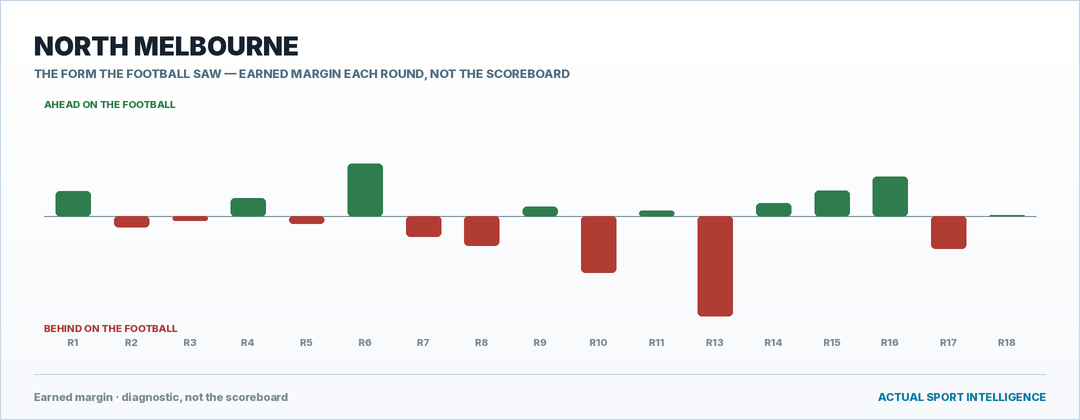
Watch North this year and the good moments arrive when the ball is already moving. Their season identity is a side that moves the ball at will — link-up, run, use of space. That's the part of their game that hums.
The contest is a different picture. They essentially split the contested ball with opponents this season, edging it by the barest margin and sitting mid-table for it. That's not a team winning off the back of the coalface; that's a team surviving the coalface and then hurting you on the transition.
Where they slip is the disrupt phase — stopping the opposition's ball movement. So the truthful football read is a side whose strength is with the footy in hand and whose vulnerability is when the other mob has it. The contest is the platform, not the weapon.
Here's what we can say cleanly. Since 2017, North have won the contested-ball count in four of ten seasons — and played finals in exactly none of them. That's the single most important number in this whole topic.
Go deeper and the link frays further. Their best contest year, 2018, was +6.4 a game and fourth in the league — they finished ninth. Their worst, 2021, was rock bottom at the contest and rock bottom on the ladder. The two lines cross rather than track together.
This season they're +1.8 a game, ninth of eighteen — a rounding error, not a foundation. With a decade of evidence pointing the same way, I'm comfortable saying the contest and the wins are not tightly coupled for this club. The claim has outrun the numbers.
The idea that North have found something new at the contest doesn't survive the archive. Four times in ten years they've won the contested count, and it delivered finals zero times. That's not a team on the cusp of a discovery; that's a well-established pattern.
Set it against the winning standard and the gap is obvious. Melbourne have won the contested ball in all ten of the last ten seasons and reached September in five of them — for the Demons the coalface and the ladder genuinely move together. That's what a contest-built side looks like.
North at +1.8 this year isn't unusual by their own history, and it's nowhere near the kind of dominance that historically converts into deep seasons. It feels fresh only because they're winning more games — but the contest number itself is business as usual.
If you're hunting for who actually changed North's season, the contested-ball leaders aren't the obvious answer, because the side barely wins that count. The players moving the needle are the ones operating with the footy already free — the runners and distributors who make the moved-at-will identity real.
Worth noting too: North's finishing has roughly matched the quality of the chances they create. No one's papering over cracks with freakish accuracy. The output is honest — the players credited for it have genuinely produced it.
So the headline risk is handing the medal to the wrong group. Crediting contested-ball winners for North's eight wins would be crediting a strength the side doesn't really have, while the transition players quietly do the work.
This is a classic case of the scoreboard writing the narrative backwards. North win a few, so we reach for a hard-nosed reason, and 'they're winning the contest now' feels satisfying. But the contest number — a whisker over even — wouldn't tempt anyone if the record were 8-9 the other way.
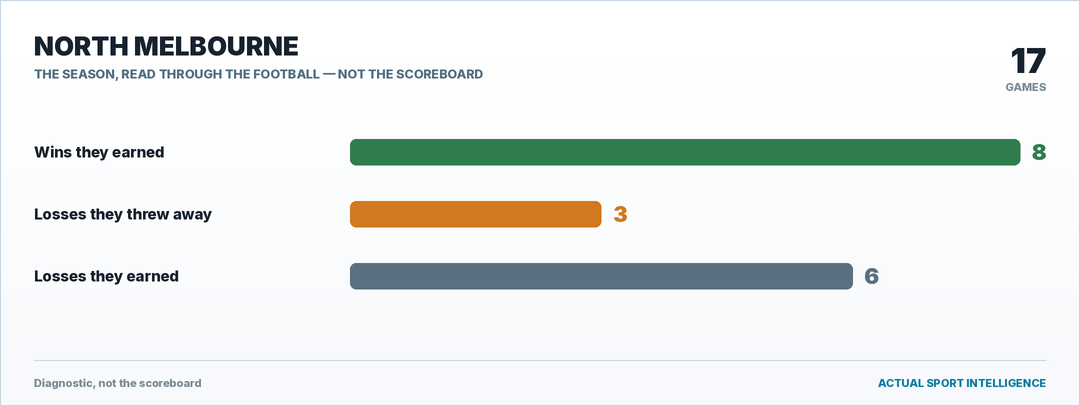
And the record deserves a closer look. Of North's eight wins, the football rates all eight as earned; their three thrown-away results are losses, not lucky wins. So the wins are real. That's exactly why we shouldn't smuggle in a false explanation for them.
Strip the outcome away and the contest line has nothing holding it up but vibe. The wins are legitimate; the reason we've attached to them is not.
Let me put the serious case for the other side. North are, in fact, on the right side of the contested ball in 2026 — +1.8 a game. It's slim, but it's positive, and it sits alongside their improved record. You can't wave that away entirely.
And history isn't purely against it. In 2018 they were fourth in the league at the contest; there's a version of North where winning the coalface is a real capability, not an accident. If this year's edge is the start of a genuine shift, the decade pattern becomes the past, not the forecast.
But here's where it breaks: +1.8 and ninth of eighteen is parity, not dominance, and 2018's stronger edge still produced ninth on the ladder. The counter-case needs the contest to be doing heavy lifting. At this margin, it simply isn't strong enough to carry the wins.
Beneath the topic sits a mix-up of platform and weapon. Every side needs to compete at the contest to stay in games — that's the floor. North clear that floor and no more, splitting the coalface roughly down the middle. Their weapon, the thing that actually separates them, is what they do once the ball is loose and moving.
The central contradiction is that we've borrowed a contest-built club's story and pinned it on a movement-built club. Melbourne are the template where coalface and ladder rise together. North are the opposite case — ten years of proof that the contest and their fortunes drift apart.
So the real headline isn't 'North win because they win the contest.' It's 'North win despite only breaking even at the contest, because they punish you with the ball in hand.' Same eight wins, completely different engine.
What the room agrees on
Every seat lands on the same core: North's contested-ball edge this season is a whisker over even, and a full decade shows their contest output and their ladder position moving largely on their own separate paths. The wins are real — the football rates all eight as earned — but the reason attached to them in the popular telling doesn't hold. Their genuine strength is ball movement; the contest is a platform they clear rather than a weapon they wield.
Where the room still has tension
The live tension is whether 2026 is the start of something. North are, for once, on the right side of the contest, and it coincides with a better record — the counter-case says don't dismiss a young side hardening up. The rest of the room answers that a +1.8 margin and a ninth-of-eighteen ranking is parity, and that even their strongest contest year in 2018 delivered nothing on the ladder. Whether this slim edge grows into a real capability is the honest open question.
What the evidence carries
What survives the whole review is this: the contested ball is not the foundation of North Melbourne's 2026. The season identity, the ten-season record and this year's near-even margin all point to a side that does its damage with the football already moving, not at the bottom of the pack.
What the evidence can't settle is the future shape of it. A positive contest number, however slim, is new-ish territory for this group, and there's a version where it becomes load-bearing. The data we have describes what's already happened; it can't tell you whether the floor is about to become a weapon.
So hold two things at once: the wins are earned, and the contest didn't earn them. Where you place the emphasis — proven movement side, or a contest edge quietly building — is the part the numbers leave open. The rest is yours to weigh.
Why it matters — Getting North's real engine right decides whether you build the list around runners and distributors or around a contest edge that history says hasn't paid off.