Melbourne Had This One Won Before the Scoreboard Caught Up
Forty-six points on the board, about fifty-five in the football. A room of seven pulls apart a Melbourne win that was more comfortable than it looked — and asks what Richmond's night actually tells us.
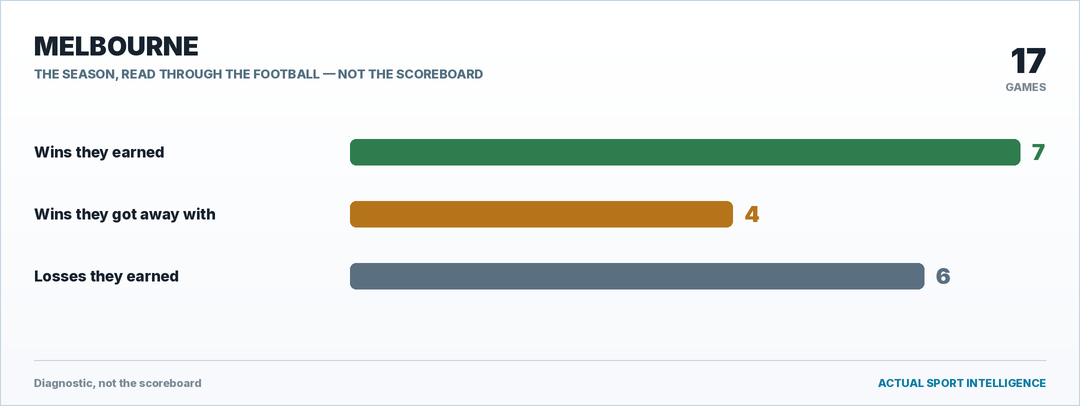
Round 18, 2026: Melbourne 111 defeated Richmond 65. The engine reads it as a True Win — Earned. Melbourne sit 11-6 and among the competition's most clinical sides; Richmond are 2-15 and leaving points on the ground all year. Seven seats, one question: how big was this really, and what does it mean?
Also in this story

This wasn't a contest decided at the coalface. The contested ball split almost evenly — Melbourne edged it, but barely. Where the game actually turned was everything after the ball spilled: Melbourne won the ground game, carrying it further and, more tellingly, laying tackles at a rate of roughly three to two. That's a side dictating tempo, not scrambling for it.
Territory told the same story. Melbourne pushed the ball inside 50 close to three times for every two Richmond managed the other way. When your season identity is moving the ball at will, that's the machine humming.
The curious wrinkle: Melbourne actually left work undone in front of goal. The quality of their looks was worth more than 111. So the football showed a side in complete control of the map — just not ruthless on the day with the reward.
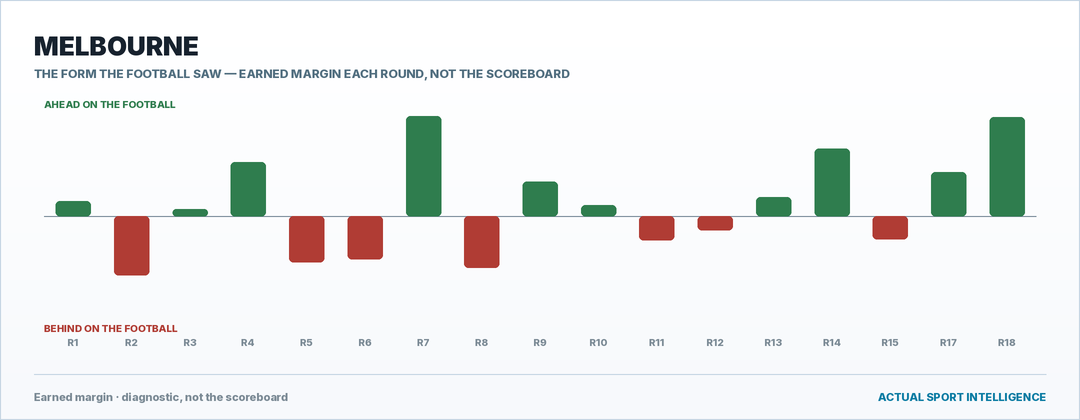
When the scoreboard, the territory count, the tackle count and the underlying chance quality all point in one direction, you can trust the reading. That's the case here. The football had Melbourne by about 55 against a result of 46 — the margin slightly understated the control rather than inflating it.
The restraint I'd add: this is one match against a 2-15 side. A dominant afternoon against the bottom of the ladder tells you a side did its job; it doesn't stretch to grand claims about ceiling.
Worth flagging too — Melbourne's chances were worth roughly 124 but they scored 111. On the day they were wasteful, which cuts against their season-long habit of finishing better than their looks deserve. One game, small sample, but noted.
Let's keep this in proportion. A top-half side handling the competition's worst team isn't news; it's the baseline. Richmond have earned 13 of their losses this year — this was the expected outcome landing on schedule.
So the question isn't the result, it's whether the performance met a genuine winning standard. Territory dominance and a pressure edge against a struggling side are the floor you'd demand, not a ceiling you'd celebrate. Melbourne cleared the floor comfortably.
What separates it from a routine flogging is the wastefulness. A side chasing finals credentials converts these games into percentage. Melbourne left a couple of goals out there against a beatable defence — against better opposition that habit costs games. Measured against the finals standard, this was a pass mark with a note in the margin.
The three Melbourne names the football rates most — Jake Bowey, Tom Sparrow, Jacob van Rooyen — map cleanly onto how this win was built. Bowey and Sparrow feed the territory and ball movement that is Melbourne's whole identity; van Rooyen is the target that turns that territory into scoreboard. This wasn't one star carrying a headline — it was the side's actual engine doing its job.
For Richmond, Tim Taranto and Sam Banks stood up in a beaten team. That's the harder read: their output is real and worth respect, but individual quality in a 46-point loss doesn't change the story, it survives it.
The honest line on both: Melbourne's best were decisive, Richmond's best were defiant. Those aren't the same currency.
This is the test that matters. Strip the 46 points away and ask what the game showed. The answer holds: Melbourne won territory near three-to-two, out-pressured Richmond three tackles to two, and generated looks worth well beyond what they scored. Had they kicked straight, this is a blowout; had they kicked worse, they still win.
So the scoreboard isn't flattering Melbourne — if anything it's slightly hiding them. The football had them by about 55.
Where outcome bias could creep in is the other direction: don't let a comfortable number convince you Richmond were disgraced. They weren't smashed at the contest. They were beaten by a side that controlled the game after the ball hit the deck. The result reflects the game honestly — which is exactly why it's a True Win, Earned.
Here's what could break the room's warmth toward this performance. Richmond are 2-15 with 13 earned losses — they are a side whose season has collapsed. Measuring anyone against them is measuring against a moving-backwards benchmark. The territory edge, the pressure edge, the inflated chance quality — all of it is what you'd expect against opposition offering little resistance.
And there's a crack in Melbourne's own display. They created looks worth 124 and banked 111. Against a genuine side, that wastefulness isn't a footnote — it's the difference between winning and losing. A team that trades on being clinical was not clinical here.
So the counter-case is simple: a comfortable win over the worst team in the league, delivered a touch loosely, tells us Melbourne turned up. It doesn't tell us they're dangerous.
Beneath the scoreline sits a clean argument. Melbourne's identity all season is that they move the ball at will and finish sharply. On this night, half of that identity was fully on display — the ball movement, the territory, the pressure that lets you dictate. That's the win, and it was earned.
The central contradiction is the other half. A side defined by clinical finishing left points out on the ground against a defence that couldn't punish it. That gap between what they built and what they banked is the tension worth watching — harmless here, expensive elsewhere.
So the headline shouldn't read as a statement about Melbourne's ceiling. It should read as confirmation of their method against confirmation of Richmond's collapse — two true things sitting side by side, neither one settling the bigger question.
What the room agrees on
The room is united on the core: this was a True Win, Earned. Every independent measure lines up — Melbourne owned territory near three-to-two, out-pressured Richmond three tackles to two, and generated scoring looks worth more than the 46 points they won by. The football actually had them by around 55. Nobody at the table thinks the scoreboard flattered them, and nobody thinks Richmond, at 2-15 with 13 earned losses this year, were unlucky. The favourite did its job, and the underlying game backs the result cleanly.
Where the room still has tension
The tension is about what it means. One half of the room reads a side executing its identity — move the ball at will, dominate the map — and sees a machine humming. The other half points at the opposition and the one crack in the display: Melbourne created looks worth roughly 124 and banked 111. For a team that trades on being clinical, being wasteful against the league's worst defence is either a shrug or a warning, depending on your seat. That gap — between a proven method and an off-day finish — is the argument the evidence can't close.
What the evidence carries
What survives the whole review is this: Melbourne controlled the terms of the game and earned every part of the margin. The territory, the pressure and the chance quality all sing the same note, and Bowey, Sparrow and van Rooyen — the side's actual engine — drove it. This was not luck and not scoreboard illusion.
What the evidence can't carry is any claim about Melbourne's ceiling. A dominant afternoon over a collapsed Richmond confirms the method; it doesn't stretch to proof of danger against the good sides. And the finishing that usually defines them briefly went missing — harmless here, potentially costly elsewhere.
So you're left with two true things: a side did exactly what it's built to do, and it did it against opposition that couldn't test it. Which one you weigh more heavily decides how much this win actually told you. The rest is yours to weigh.
Why it matters — It separates a genuinely earned win from proof of contention — the same result can mean very different things depending on who you beat.