Melbourne Win the Contest Every Year. That's Not the Story.
The Demons have owned the coalface for a decade — so if the contested ball were the whole answer, we'd already know it. The evidence points somewhere quieter.
Melbourne sit 11-6 in 2026 and the easy line is that it's built on winning the hard ball. The Actual Sport room put that claim under seven lights: a club that has won the contested-ball count in ten straight seasons, a modest +3.8 edge this year, and a season identity that reads 'moved the ball at will'. What survives is a question about foundations versus engines.
Watch Melbourne in 2026 and the coalface isn't where they hurt you. They're averaging 134 contested possessions to their opponents' 130 — a slim edge, about one contested ball in two, ranked seventh of eighteen. That's a side holding its own at the contest, not dominating it.
Where they actually do damage is once the ball's in motion. Their season identity is a group that moves it at will and finishes clinically — they convert better than the raw quality of their chances suggests. The contest gives them the ball; the ball movement and the scoreboard end do the separating.
So the football on show says: the hard ball is the platform, not the point of difference. If you're crediting Melbourne's year to grunt in close, you're watching the first two seconds of a chain and missing the twenty that follow.
Here's the statistical trap. Melbourne have won the contested-ball count in ten of their last ten seasons. A factor that's present every year can't explain why they made finals in five of those and missed in the others — a constant doesn't cause a variable.
Within the club, the signal that does track is size of edge. Their best contest year, 2018, was +16.5 a game, first in the league, and they finished fifth. Their weakest, 2024, was +1.6 and they finished twelfth. So a bigger edge has tended to travel with better seasons.
But 2026 complicates it: a modest +3.8, seventh in the league, and they're 11-6. That's a good record on an ordinary contest platform. The honest read: contest is necessary background, correlated with their better years, but this season it isn't carrying the load.
Set it against the standard. Owning the contested ball ten seasons running sounds like an identity, but for any side with finals ambitions it's closer to the price of entry than a rare feat. The archive is full of teams who win the hard ball and go nowhere.
North Melbourne make the point cleanly. They've won the contested count in four of their last ten seasons and played finals in none of them. Winning it simply hasn't moved their ladder position; their contest output and their finishes have drifted independently for a decade.
So what's actually fresh about Melbourne 2026 isn't that they win the contest — they always do. It's that they're 11-6 while winning it only narrowly, seventh in the league. That decoupling is the unusual bit, and it cuts against the headline rather than supporting it.
The topic hands the credit to the inside brigade — the bodies over the ball, the clearance men. That's who a 'built on the contest' story crowns. And they're doing real work: Melbourne hold the contest even in a year where the edge is slim.
But the team-level signal points the reward elsewhere. Melbourne convert better than the quality of their chances suggests — that's finishing, forward-half craft, decision-making in the front half, not coalface grunt. The players changing the scoreboard aren't necessarily the ones filling the contested column.
I'll be straight about the limit: the evidence pack holds no individual player numbers, so I can't name who's tipping games. What I can say is that the club's fingerprint — clinical conversion off good ball movement — rewards a different kind of contributor than the headline assumes.
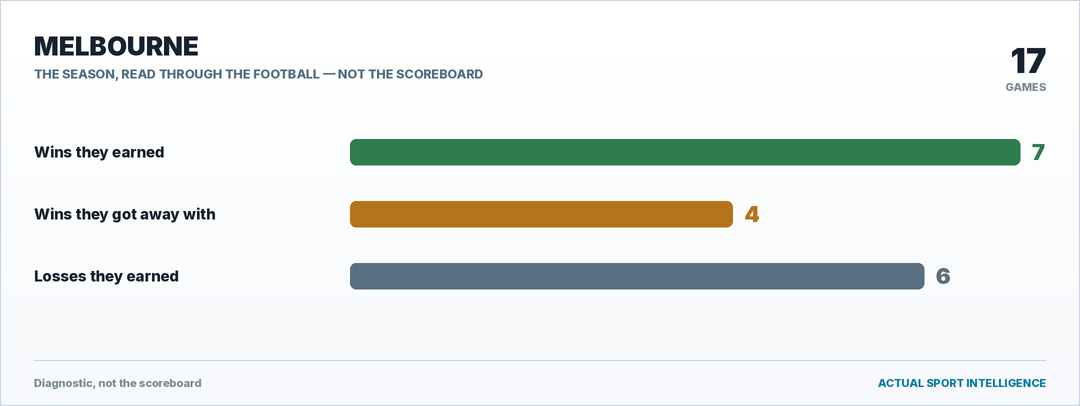
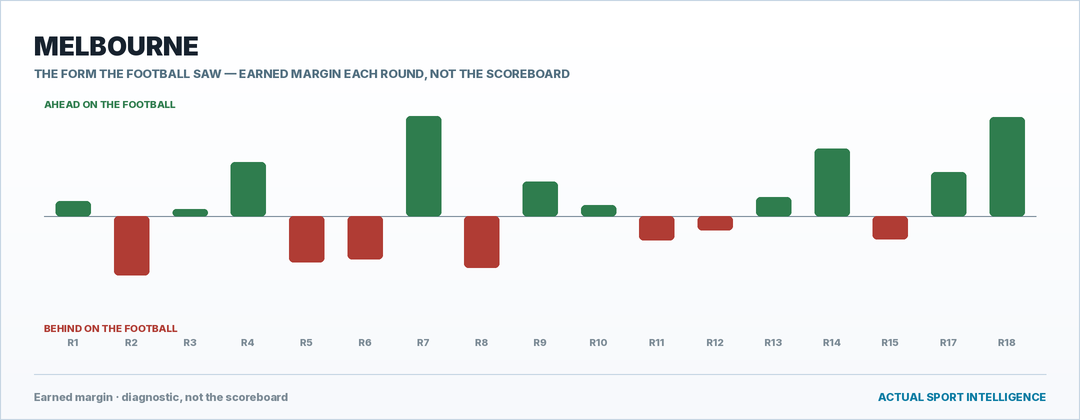
The 11-6 is doing heavy lifting in this conversation. The football's own read of those seventeen games is seven wins they earned, four they got away with, and six losses they earned. That's an earned record closer to 7-6 than 11-6.
Now ask the outcome-bias question. If those four fortunate wins had flipped, we'd be looking at a mid-table side and nobody would be writing that Melbourne's season is 'built on' anything. The contested-ball number wouldn't have changed — they'd still be +3.8 — but the story wrapped around it would evaporate.
That's the tell. When a narrative depends on the wins landing rather than the underlying performance, the scoreboard is writing the analysis. The contest didn't rescue the four they got away with; something else did, and it wasn't grunt in close.
The room is leaning toward 'contest is just the floor', and that risks overcorrecting. Look again at Melbourne's own decade. Their standout contest year, 2018 at +16.5 and first in the league, was a finals year. Their limpest, 2024 at +1.6, was a twelfth-placed finish. That's not noise — that's the coalface and the ladder moving together, season after season.
So the case that survives is this: contest may be the enabling platform on which the ball movement and finishing are built. You can't convert what you don't win first. A slim edge this year doesn't disprove that — it may simply mean the platform is thinner and the finishing is papering over it.
If 2026's conversion cools, we'll learn whether a +3.8 base can hold a side up. The contest deserves more than a supporting credit until we see that.
Strip it back and the shape is clear. Melbourne always win the contested ball — ten from ten. What actually swings between their good years and their flat ones is how well they move it and how clinically they finish. The topic asks whether success is 'built on' the contest, and the honest answer is that the contest is the concrete slab, not the house.
The central contradiction is that both the strongest supporters and the sceptics can point to the same ledger. Yes, bigger contest edges have tracked better seasons within the club. But this very year — modest edge, still 11-6 — is the exhibit that says the front-half work is doing the separating.
The headline shouldn't read 'built on the contest'. It should read: the contest gets Melbourne the ball; what they do next is the story.
What the room agrees on
The room agrees the contested ball is a Melbourne constant, not a variable: they've won the count ten seasons running, and this year they win it only narrowly at +3.8, seventh of eighteen. Everyone accepts the club's real fingerprint is elsewhere — moving the ball at will and finishing more clinically than their chances deserve. North Melbourne's decade — winning the contest four times, playing finals none of those — reinforces that owning the hard ball guarantees nothing on its own.
Where the room still has tension
The tension is whether the contest is merely the floor or a load-bearing platform. Priya and David read a constant that can't explain a changing outcome; Marcus notes the 11-6 flatters an earned 7-6 record and the fortunate wins weren't rescued by grunt. But Helen's counter holds real weight: within Melbourne's own decade, the biggest contest edge (2018, +16.5) came with a finals year and the smallest (2024, +1.6) with a twelfth-placed finish. Same ledger, two defensible stories.
What the evidence carries
What the evidence carries is this: Melbourne's success is not built on winning the contested ball, because they win it every year regardless of where they finish. In 2026 they hold the contest only narrowly and still sit 11-6, with the separation coming from ball movement and clinical conversion — the parts of their game the headline doesn't mention.
What the evidence can't settle is how much that slim contest edge is quietly enabling everything downstream. The within-club history says bigger edges and better years travel together; this season says you can prosper on a modest one. Both are true, and there's no player-level data here to break the tie by showing who's actually tipping games.
So the fair framing isn't 'contest, yes or no' — it's foundation versus engine. The contest gets Melbourne the ball; the finishing decides the scoreboard. Which of those you call the 'success' is the judgment the numbers hand back to you. The rest is yours to weigh.
Why it matters — Get this wrong and you build a side around grunt Melbourne already have, while the thing actually winning them games goes uncredited.