Hawthorn And The Contest: Foundation, Or Just The Floor?
The Hawks are winning the hard ball again in 2026 — but a decade of their own history says that's rarely what carries them up the ladder. Is the contest the engine, or just the platform?
Hawthorn sit 11-5-1 through 17 rounds of 2026 and are winning the contested-ball count for the first time in a few years. The easy story writes itself: tough Hawks, built on the coalface. But the club's own ten-year ledger keeps refusing to cooperate with that story, and their 2026 identity points somewhere else entirely.
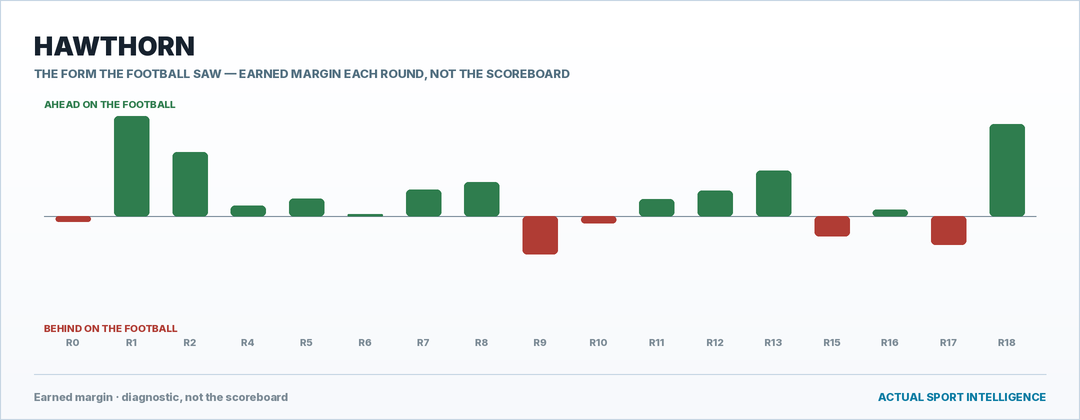
Watch Hawthorn this year and the hard ball is fine — they're edging the contested count by roughly four-and-a-half a game, winning a shade over half of it, sitting 5th of 18. That's a solid platform, not a weakness.
But the platform isn't the point of difference. Where this side actually hurts opponents is once the ball is loose and going forward — they move it at will. That's the season identity. The contest gets them the ball; the transition is what turns it into scoreboard.
The honest wrinkle: they leave points on the ground, scoring less than the quality of their chances is worth. So the story isn't 'win the contest, win the game'. It's 'win enough of the contest to launch, then live or die on ball movement and finishing.' The coalface is the setup, not the punchline.
Here's what we can say cleanly. Since 2017 Hawthorn have won the contested-ball count in 4 of their last 10 seasons, and played finals in 3 of those. That's a link, but a loose one — plenty of their finals appearances don't line up neatly with owning the contest.
The cleaner signal cuts against the headline: across the decade, their contested output and their ladder position have moved largely independently. In 2018 they finished 4th while ranking 12th at the contest and losing it by four a game. That single data point does a lot of damage to a causal story.
So 2026 — +4.5 a game, 5th, good record — is real, but it's one season. Correlation in a single year isn't a foundation. The claim has outrun what the numbers can bear.
Put 2026 against Hawthorn's own decade and the drama softens. A +4.5 contested edge for 5th in the league is good, not extraordinary — it's roughly where they sat in their strongest contest year, 2024, when they ranked 3rd and still only finished 6th.
Now read the archive the other way. Their worst contest season, 2020, was a genuine cellar-dweller: beaten by nearly fourteen a game at the contest, dead last, 16th on the ladder. That's the one year the story holds cleanly — lose the contest badly, finish badly.
But 2018 blows it apart: 4th on the ladder while ranking 12th and losing the hard ball. Against the club's own baseline, contest strength is neither rare nor reliably attached to how high they finish. It's a lever they've pulled at very different settings for very different results.
This is where honesty beats confidence. The evidence pack carries team-level contest numbers and a decade ledger, but nothing on individual players — no clearance winners, no inside-mid loads, no forward-half contributors.
So the responsible read is a flag, not a name. When a side wins the contest by a slim margin as a group, the story is usually distributed — a couple of contest bulls doing heavy lifting, midfielders sharing the load, and forwards winning ground-level ball that never shows up in a highlight. But which of those is true here, I can't tell you from what's in front of me.
What I can say: given the season identity is ball movement and finishing, the players changing games are as likely to be the ones using the ball well going forward as the ones winning it in tight. That's a guess the data doesn't yet let me confirm.
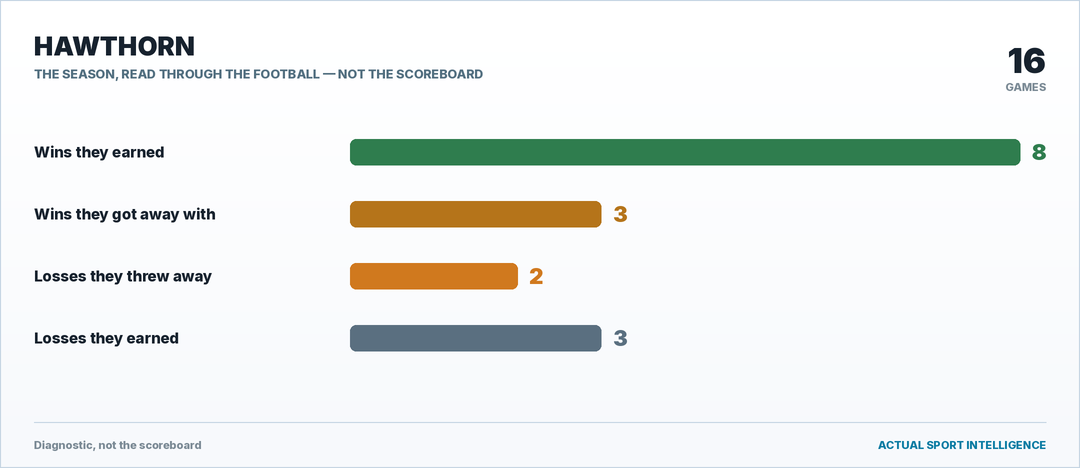
Look past the 11 wins to how they were won. The football's read on the 17 games: 8 wins genuinely earned, 3 they got away with, and among the losses, 2 they threw away. The record flatters the performance.
Strip the three fortunate wins and Hawthorn are closer to 8 earned wins in 17 — a distinctly more ordinary team. Would anyone be calling them contest kings at 8-8-1? The 'built on the hard ball' narrative is riding on a record that's partly luck, not just method.
That's the outcome-bias trap. The contested edge is the same whether they win by six points or lose by six. But we only reach for the tough-Hawks story because the wins landed. Change three coin-flips and the same contest numbers get read as 'nice at the coalface, but couldn't finish' — which, given they leave points on the ground, may be nearer the truth.
Let me push back on the room. The doubters lean hard on 2018 — good finish, bad contest — as the exception that kills the rule. But exceptions cut both ways. In 2020, when Hawthorn were flogged at the contest by nearly fourteen a game, they finished 16th. That's not independence; that's a floor collapsing.
And right now, in 2026, the two are lining up: they're winning the hard ball, 5th in the league, and holding their best record in years. You can argue ball movement is the weapon — but you can't move a ball you don't win. Contest may not be the whole engine, but it might be the thing that has to be in place before the ball movement means anything.
Dismiss the contest entirely and you have to explain why their worst contest season was also their worst season full stop.
Strip it back and the room is circling one confusion. 'Built on contested ball' treats winning the hard ball as the cause of success. The evidence keeps pointing to it as a precondition instead — necessary at the low end, but nowhere near sufficient at the top.
Here's the shape. When Hawthorn lose the contest badly, they sink (2020). But winning it doesn't lift them proportionally — 2024's strong contest year brought only 6th, and 2018 reached 4th while losing the hard ball outright. Over the decade, the two move largely independently. This season the contest and the record finally rhyme, but the identity underneath is ball movement and a finishing problem, not coalface dominance.
So the headline should read: Hawthorn win enough contest to play their real game — moving the ball — and their ceiling is set by how well they use it and finish, not by how hard they win it. The contest is the floor. The story lives upstairs.
What the room agrees on
Every seat accepts that Hawthorn are genuinely winning the contested ball in 2026 — a slim edge, roughly four-and-a-half a game, 5th of 18 — and that this is a real strength, not spin. The room also agrees the season identity is ball movement, that they leave points on the ground by under-finishing their chances, and that the decade ledger shows contest output and ladder position moving largely independently. Owning the hard ball has never, on this club's own record, translated cleanly into finishing higher.
Where the room still has tension
The tension is over what the contest is FOR. Marsh makes the sharpest challenge: their one catastrophic contest season (2020) was their one catastrophic year overall, so contest may be a non-negotiable floor rather than a bystander — and 2026 is the year it finally lines up with results. Webb counters that the record itself is inflated: 3 of the 11 wins were fortunate, so the 'tough Hawks' read may be borrowing credibility from luck. And Morrison flags the honest hole in the middle — with no player-level data, nobody in the room can actually name who's driving the contest, or whether it's the same players driving the wins.
What the evidence carries
What survives the whole review is this: winning the contested ball is real for Hawthorn in 2026, but the evidence does not carry it as the foundation of their success. The decade says the two barely track together. The season identity says the damage is done in transition. The record says three of the wins were fortunate. Put together, the contest looks like a platform — something that has to be there for the rest to work — rather than the engine.
What the evidence cannot settle is the direction of the arrow this year. For the first time in a while, contest strength and a strong record are sitting side by side, and Marsh's floor argument means you can't wave that away as coincidence. Without the player-level detail, the causal question stays open.
So the honest position is narrow but firm: contest is Hawthorn's floor, ball movement and finishing are their ceiling, and 2026 is the year those two things happen to agree. Whether that agreement is cause or coincidence — the rest is yours to weigh.
Why it matters — Getting this right changes what you'd point to if Hawthorn's season turned — the contest, or the finishing they keep leaving on the ground.