Hawthorn 103, Carlton 39: the football agreed with the scoreboard — for once
One round, seven ways of looking at it. Hawthorn's win at Round 18 wasn't a mirage — but what it says about two seasons is a different question.
Round 18, 2026: Hawthorn beat Carlton 103 to 39. The scoreboard says blowout. The engine's plain-football read says the margin was, if anything, a touch flattering to Carlton. This is the room pulling that apart — what the game showed, what it means for two clubs sitting on very different ledgers, and what it still can't tell you.
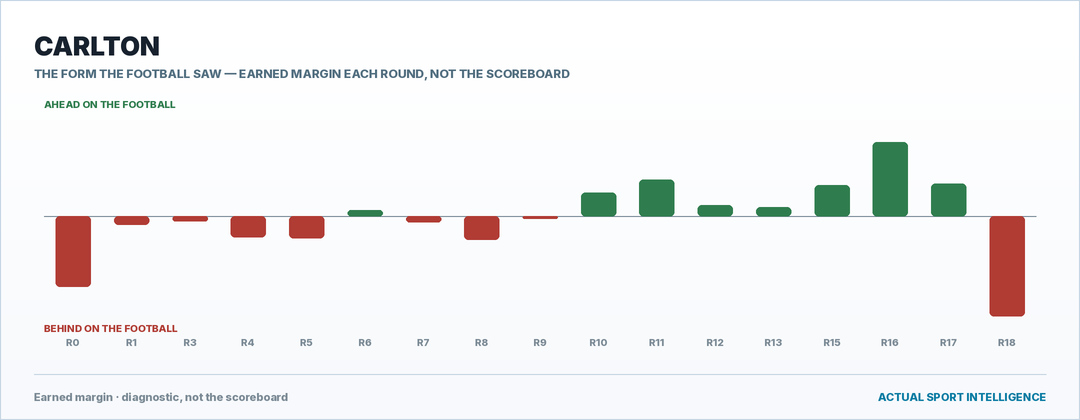
This wasn't a smash-and-grab. Hawthorn won the contested ball and edged the territory battle, carrying the footy further and getting it forward more often. When a side wins the hard ball and the ground behind it, the scoreboard usually follows — and it did.
The telling detail sits in the tackle count. Carlton laid more tackles than Hawthorn, which sounds industrious but often means one thing: you're chasing. You tackle a lot when the other side has the ball and is moving it where it wants. Hawthorn dictated; Carlton reacted.
Hawthorn's chances were worth more than the 103 they kicked — their looks at goal graded out near 117. Carlton's were worth about what they scored. So the football wasn't just cleaner at one end, it was better structured across the whole ground.
On the day, the signal is clean. Hawthorn out-graded Carlton on the quality of chances — about 117 to 38 — and won the underlying contest. The result reading Hawthorn by 64 while the football read them by around 79 tells you the margin, if anything, understated the gap. That's a coherent, high-confidence single-game picture.
What one match can't do is redraw two full ledgers. Carlton sit 8-9, Hawthorn 11-5-1. Those are 17-game samples, and they carry far more weight than any single Saturday.
So hold two thoughts at once: this game was real and earned, and it's still only one data point against a season's worth of them. Don't let the size of the margin do the work of a trend.
Against the winning standard, this is a strong day out, not an outlier. Hawthorn's season identity is moving the ball at will, and that's exactly how they won — dictating terms and getting the footy forward. The performance confirmed who they've been, it didn't reinvent them.
Carlton's stumble also rhymes with their year. Their weakness is disruption — stopping the opposition's flow — and Hawthorn's whole game is flow. This was a bad match-up meeting a known flaw, not a freak collapse.
Even the shared trait shows up: both sides have spent 2026 leaving points on the ground, scoring less than their chances are worth. Hawthorn broke that pattern here, kicking below what 117 deserved but still clinical enough to bury it. Familiar tendencies, one loud scoreline.
Hawthorn's most decisive names tell a story of balance — Blake Hardwick and James Sicily anchoring the defensive half, Jack Gunston doing damage the other way. When your best work comes from both ends, you're not leaning on one man to paper over cracks. That's a side functioning as a system.
Carlton's story is thinner. Adam Cerra and Sam Walsh were their best, which is no surprise — but two midfielders standing up in a 64-point loss usually means the contributions around them dried up. They were carrying the load, not changing the result.
That's the quiet truth behind the scoreline: Hawthorn's contributors reinforced each other, while Carlton's best simply kept the fight honest for a while before the numbers around them told.
This is the test that matters most: strip the 103-39 away and ask if the story holds. It does. Hawthorn won the contested ball, won the territory, carried the footy further and created better-quality chances. Every underlying lever points the same direction as the result.
That's rare. Plenty of big margins are inflated by a wasteful opponent or a hot ten minutes. Here the football had Hawthorn by about 79 against an actual margin of 64 — the scoreboard, if anything, was kind to Carlton. There's no contamination to correct for.
So the scoreboard isn't lying to you this week. Where you should stay disciplined is the leap from 'Hawthorn were clearly better on the day' to 'Hawthorn are 64 points better' — that's the outcome talking, not the evidence.
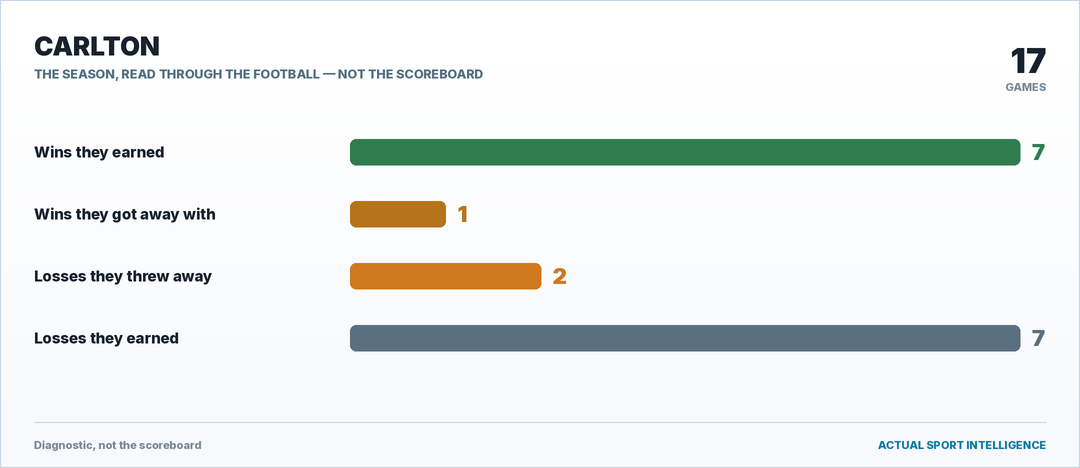
Grant Hawthorn the day; it's earned. The case worth pressing is the ledger beneath the record. Hawthorn are 11-5-1, but the football's own reading credits only eight of those wins as truly earned and flags three as games they got away with. Take those three at face value and the gap between the clubs narrows considerably.
Carlton, meanwhile, are 8-9 with seven wins graded as earned — the same earned-win count as Hawthorn. Their record is dragged down by seven losses they earned and two they threw away, not by an inability to play good football. Their identity — moving the ball at will — is the same strength Hawthorn own.
So the challenge stands: this match-up flattered the distance between them. On a day that didn't suit Hawthorn's flow, the story could read very differently.
Beneath the 64 points is a contradiction worth holding. The single game was emphatic and honest — Hawthorn better in every phase that matters, the margin if anything understated. On that, the room barely argues.
But zoom out and the two clubs share a spine. Same core strength — moving the ball at will. Same season-long habit of leaving points on the ground. And, strikingly, the same number of genuinely earned wins across 17 rounds. The ladder separates them; the earned football doesn't, quite as much.
So the headline shouldn't be 'Hawthorn are 64 points better than Carlton'. It should be 'Hawthorn's identity beat Carlton's weakness on a day built for it'. One is a claim about a match. The other is a claim about a season — and only the first is settled here.
What the room agrees on
Every seat accepts the win as real. Hawthorn controlled the contested ball, edged the territory, carried the footy further and created better chances — worth about 117 against Carlton's 38. The football read the margin at roughly 79 against an actual 64, so nobody's arguing the scoreboard flattered the winner. The stamp is plain: earned, across the whole ground, with contributions from both ends rather than one carried headline.
Where the room still has tension
The tension is about scale. The scoreboard, player and football seats see a side imposing itself; the evidence, baseline and counter-case seats warn against reading a season into it. And the awkward fact underneath: Carlton and Hawthorn have the same number of truly earned wins across 17 rounds, and share the same core strength. The ladder gap is real; the earned-football gap is narrower — and this match-up, flow versus a side weak at disruption, was built to widen it.
What the evidence carries
What survives all seven seats is this: on Round 18, Hawthorn were clearly and honestly the better team, and the margin was no accident. That much the evidence carries without strain.
What it can't carry is the leap from one day to two seasons. Carlton lost the way their year says they lose — good ball movement, no answer to an opponent's flow — while Hawthorn won the way their year says they win. Both are still leaving points on the ground. Both have banked the same count of earned wins. The scoreline made them look like different classes of side; the ledger says they're closer than that.
So hold the game and the season apart. One is settled here. The other isn't. The rest is yours to weigh.
Why it matters — Reading a 64-point scoreline as proof of a 64-point gap is exactly the trap that turns one honest result into a wrong story about two teams.