Geelong And The Contest: The Story The Coalface Tells, And The One It Doesn't
For a decade Geelong's fortunes and their contested-ball count have moved together. In 2026 they sit mid-table at the coalface and mid-table on the ladder — so the question is whether the contest is still doing the work, or just keeping them company.
Geelong sit 9-8 through 17 games in 2026, a club long defined by winning the hard ball. This is a look at whether that reputation still explains where they are — and where the evidence stops short of the story fans tell.
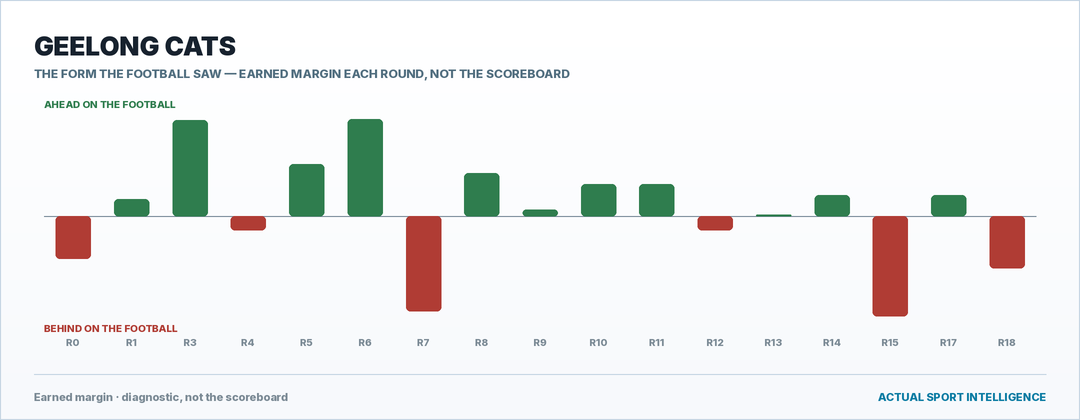
Watch this Geelong side and the coalface isn't where the game turns. They're winning the contested ball by the barest margin — 136 to their opponents' 134, a fraction over two a game, eighth in the league. That's not domination; that's a coin toss with a lean.
Where they actually hurt sides is once the ball's in motion. Their season identity is a team that moves the ball at will — clean transition, ground gained, chains that arrive inside 50 with shape. Where they slip is disrupting the opposition doing the same back to them.
So the football on show says the engine isn't the contest. It's the run and the connection. The hard ball keeps them in the arm-wrestle; the ball movement is what tips games their way when they're tipped at all.
The long pattern is real: since 2017 Geelong have won the contested-ball count in eight of their last ten seasons, and played finals in eight. That's a strong association. But association isn't a lever you can pull.
The honest problem is 2024. That year they finished third — a genuine top-end season — while ranking eleventh of eighteen at the contest and actually losing it, down 1.1 a game. If contested ball built the success, that season shouldn't exist. It does.
This year the contest is a near-dead-heat, plus two a game. The safe statement is narrow: Geelong usually win the hard ball and usually go deep, but their strongest recent year came without the contest, and this year's contest edge is too thin to lean a story on.
Set against Geelong's own archive, this season doesn't stand out — it's slightly below their line. They've been contested-ball winners in eight of ten seasons, so a plus-two-a-game, eighth-ranked year is a soft version of their usual self, not a fresh identity.
The real yardstick sits in 2019: plus 11.8 a game, first in the league, first on the ladder. That's what contest dominance actually looks like for this club. Beside it, 2026's margin is a whisper.
So when someone says Geelong's success is 'built on the contest', the baseline asks: which Geelong? The 2019 version, yes, emphatically. The 2024 version finished third doing the opposite. The 2026 version is neither — a mid-table contest team sitting mid-table. It feels unusual only if you'd forgotten how far the standard has drifted from the peak.
There's no individual here to crown, and that's the point. The evidence doesn't hand us a contested-ball colossus dragging Geelong up the ladder. It hands us a team profile: best at moving the ball at will, thinner at disrupting the opposition.
That shifts who carries the story. The players changing games aren't necessarily the inside grafters winning the hard ball at the stoppage — the contest is level. The ones doing the load-shifting are the runners and connectors who turn a neutral coalface into ground gained and a clean entry.
So if a fan wants to credit the 'contested-ball Cats', the player-truth read gently redirects: the hard-ball winners are holding the line, but the ones actually authoring the wins are the movers. Same jumper, different job.
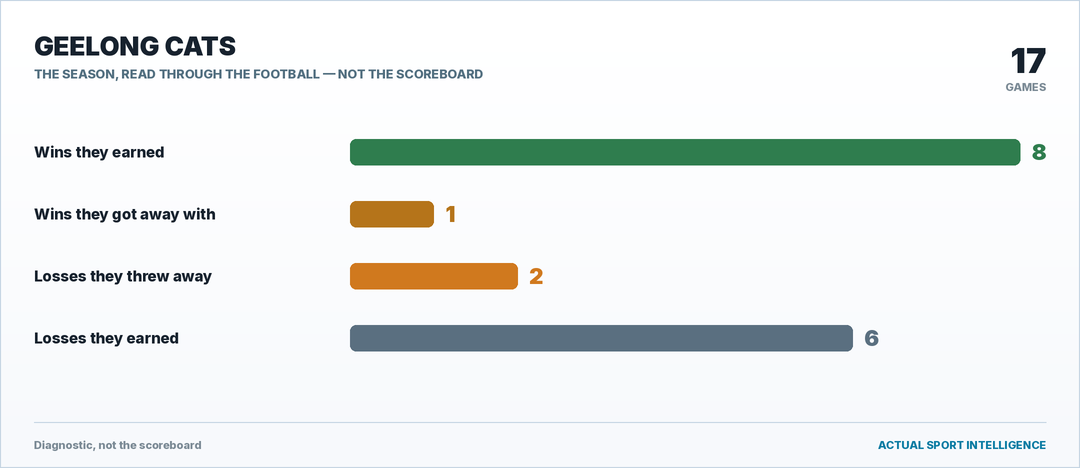
Outcome bias thrives when a season shines. This one doesn't, particularly. Nine wins, eight losses. And the football's own audit is unsentimental: eight wins genuinely earned, one that got away with it, two losses thrown away and six flatly earned. That's a side roughly getting what it deserved.
Here's the scoreboard trap. In seasons Geelong win big, we point at the contest and call it the reason. In 2024 they finished third — and nobody said 'built on the contest', because they were losing it. The story follows the result, not the mechanism.
Flip 2026's close games and this becomes a 7-10 side, and the same plus-two contest margin would be filed as 'not winning the hard stuff'. Same number, opposite headline. That's the tell that the contest isn't explaining the record — the record is explaining the contest.
Let me put the case for the tradition. Eight contested-ball wins in ten seasons, eight finals campaigns — you don't stumble into that. For this club, the coalface and the ladder have genuinely moved together, and dismissing it as coincidence is its own kind of overreach.
And note what 2026 is not: they are not losing the contest. Plus two a game, eighth of eighteen — that's the right side of the ledger. A team that has built a decade on winning the hard ball is still, quietly, winning it. Their eight earned wins didn't come from a side being pushed off the ball.
The disruption weakness cuts the other way too: struggling to stop the opposition's ball movement is a defensive-transition problem, not evidence the contest doesn't matter. Strip the contest out entirely and this 9-8 might be 6-11.
Underneath the argument is a club whose identity and whose engine have quietly drifted apart. For years, 'Geelong win the contest, Geelong win' was true enough to become a law. The room's tension is that the law now only half-holds.
The contradiction is clean. The tradition (Michelle) and the loyal case (Helen) say: eight from ten, eight finals, still on the right side of the ledger — this is who they are. The football and the numbers (James, Priya, Marcus) say: the contest is a near dead-heat, the wins are coming from moving the ball, and their best recent season in 2024 came while losing the hard ball outright.
So the headline shouldn't read 'built on the contest'. It should read: Geelong still win the hard ball out of habit, but in 2026 the coalface is holding the floor while the ball movement — and the failure to disrupt — is deciding the games.
What the room agrees on
Every seat accepts the long association: since 2017 Geelong have won the contested-ball count in eight of ten seasons and played finals in eight, and for this club the coalface and the ladder have genuinely tended to move together. The room also agrees on the present-tense facts — this year the contest is a near dead-heat, plus two a game, eighth of eighteen — and that the season itself is honestly mid-table, nine wins and eight losses, with eight of those wins genuinely earned.
Where the room still has tension
The split is over what the contest is doing now. The tradition and loyalist seats say a decade of eight-from-ten and eight finals is real gravity, and a side still on the right side of the ledger is still living its identity. The football, evidence and scoreboard seats counter that the margin is too thin to build a story on, that the wins are coming from ball movement rather than the coalface, and — most damaging — that in 2024 Geelong finished third while ranking eleventh and actually losing the contest. That one season is the crack the whole claim has to survive.
What the evidence carries
Here's what survives all seven seats. Geelong winning the contested ball is real and long-running, but it reads better as a club habit than as the lever behind 2026. This year the hard ball is level, not dominant, and their best football is coming from moving the ball at will — while their soft spot is stopping the opposition doing it back.
The 2024 season is the fact that won't sit down: a top-three finish built without winning the contest at all. That single data point turns 'built on the contest' from a foundation into a correlation — one that held for years, broke recently, and is barely present now.
What the evidence can't tell you is whether the contest is the quiet floor keeping this 9-8 from collapsing, or a fading trademark this side has already moved past. Both readings fit the same numbers. That call — habit or engine — is yours to weigh.
Why it matters — How Geelong read their own contest number decides whether they double down on the coalface or invest in the run that's actually winning them games.