Fremantle Are Winning The Contest. Is That Why They're Winning?
Fremantle sit 15-2 and rank second in the league for contested ball. But a decade of their own history says the two things don't always travel together. The room reads the whole thing.
Fremantle have had their best contested-ball season on record in 2026 — +6.2 a game, second in the league — while also sitting near the top of the ladder. It's tempting to draw a straight line between the two. The engine's plain-football reads across seven seats test whether that line actually holds, using Fremantle's own results from 2017 to 2026.
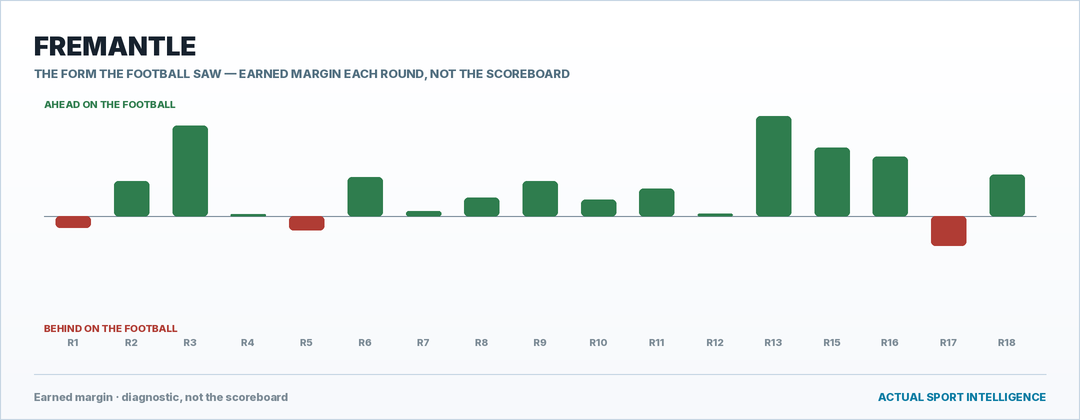
Watch Fremantle and the contest is real. They're second in the league at winning the contested ball, edging their opponents at the coalface week after week. That's not noise — it's a genuine strength, and their strongest year at it in a decade.
But the football shows the payoff isn't at the contest itself. Fremantle's best work this year is moving the ball at will once it's loose — transition, run, ball movement. Where they slip is control: holding the game on their terms when they're not scoring. The contest gives them the ammunition; the damage comes from the carry.
So the honest football read is that the contest is a foundation, not the finish. They win it, then they hurt you somewhere else.
Here's what we can say cleanly. This season Fremantle are +6.2 contested possessions a game, second of eighteen, and they're 15-2. Those two facts are real and they sit side by side.
Here's where confidence drops. Across the last ten seasons, Fremantle's contested-ball output and their ladder finish have moved largely independently. They won the contest count in five of ten years and only played finals in three of them. Just last season, 2025, they finished fifth while ranking eleventh at the contest — actually losing it, -1.0 a game.
So one strong year of alignment isn't proof of a mechanism. Correlation in a single season, against a decade of drift, is a pattern to watch, not a law to declare.
Against Fremantle's own baseline, 2026 stands out. Second in the league at the contest is their best mark since 2017, and it's a long way from the bottom-of-the-ladder version of this club that ran -10.6 a game and finished seventeenth of eighteen back in 2017.
So yes, this is unusual for Fremantle. But the archive also cools the story. In five of the last ten seasons they've won the contest count and only reached finals three times. The contest number has swung wildly; the winning hasn't tracked it.
What's actually fresh isn't the contest dominance on its own — it's that this year they've got the contest AND the ladder position together. History says that pairing is the exception, not the rule.
There's no single name to hang this on. Fremantle's contest edge is a team output — +6.2 a game means a group winning the hard ball, not a lone bull dominating stoppages. That's worth saying, because the headline wants a hero and the football gives you a unit.
The players actually changing games are further up the ground. Fremantle's identity this year is moving the ball at will — that's the ball-users, the runners, the ones turning a won contest into a scoring chance. The engine notes their finishing has roughly matched the quality of the chances they create, so the value is in manufacturing good looks, not stealing goals from bad ones.
The contest-winners set the table. The transition players eat.
Flip the scoreboard and test the story. Fremantle are 15-2, so every strength gets read as the reason. Win the contest? Must be why they're winning. It's a clean, satisfying line — and it's exactly the kind of line the result manufactures.
But we don't need a hypothetical. Look at 2025. Same club, finished fifth, and they were eleventh at the contest, losing it by a possession a game. Nobody was writing 'built on the contest' then, because the contest number was ordinary and the ladder was fine anyway.
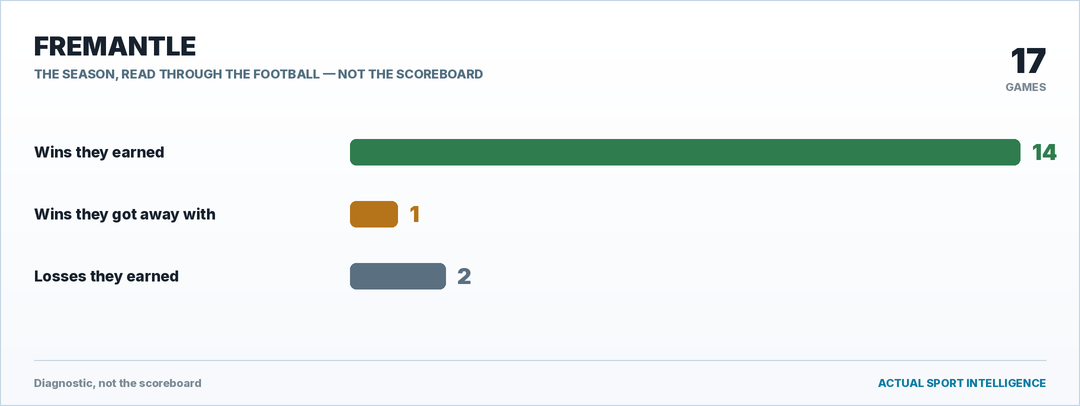
The engine's own read on this year: fourteen wins earned, one they got away with, two losses earned. This is a genuinely good side. But 'good side that also wins the contest' is not the same as 'good because it wins the contest'. The scoreboard is quietly welding those two together.
Let me put the firmest possible case for the contest theory, because the room is leaning cautious and caution can become its own blind spot. The single best contested-ball year in Fremantle's decade — +6.2, second in the league — has arrived alongside a 15-2 record and top spot. That is not nothing. When your best-ever version of a strength shows up in your best-ever season, dismissing the link is as lazy as assuming it.
The 2025 counter-example cuts both ways too. Yes, they finished fifth while poor at the contest — but fifth isn't 15-2. The gap between good and dominant may be exactly the contest lift they've found this year.
And the football agrees the contest supplies the ammunition. A side that can't win the hard ball can't move it at will, because it never has it. The contest might not be the whole story — but it could be the floor everything else is standing on.
Strip it back and the argument has a clean shape. Everyone can see two true things: Fremantle are winning the contest at a rate they never have, and Fremantle are winning games. The headline welds them. The room keeps prising them apart.
The central contradiction is history. This club has won the contest before and gone nowhere — five of ten seasons on top of the count, finals only three times, fifth last year while losing the contest outright. So the contest can't be a reliable cause of success, because Fremantle's own record shows success without it and it without success.
What's genuinely new in 2026 is the pairing — and the football says the join between them is ball movement. They win it, then they move it at will. The contest is the foundation. The carry is the story. The headline should read: not built on the contest, but standing on it.
What the room agrees on
Every seat accepts two facts: Fremantle's 2026 contest year is their best in a decade (+6.2 a game, second in the league), and they're a genuinely strong side at 15-2 with fourteen earned wins. The room also broadly agrees the contest is a real strength worth crediting — a foundation the rest of their football stands on. Where the ball-winning turns into scoring is in transition: their identity this year is moving the ball at will, and their finishing has matched the chances they create.
Where the room still has tension
The tension is cause versus coincidence. The Counter-Case argues the best-ever contest year and best-ever season arriving together is too clean to dismiss — the contest may be the floor that lifts them from good to dominant. The Evidence, Baseline and Scoreboard seats push back hard: Fremantle won the contest in five of ten seasons and made finals in only three, and in 2025 they finished fifth while actually losing the contest. One year of alignment against a decade of drift isn't proof. That gap is the whole argument, and it isn't resolved.
What the evidence carries
What survives the whole review is this: the contest is real, it's a career-best year at it, and it feeds a side that does its best work moving the ball. That much the evidence carries firmly.
What the evidence cannot carry is the word 'built'. Fremantle's own record from 2017 to 2026 shows contest output and ladder position moving largely independently — including a fifth-placed finish last year while losing the count. You cannot call something the foundation of success when the same club has succeeded without it and had it without succeeding.
So the honest position sits between the headline and the sceptic: the contest is a strength this side is finally pairing with everything else, and the ball movement is where the damage lands. Whether that pairing is cause or coincidence is the one thing a single season can't settle — the rest is yours to weigh.
Why it matters — How you answer this decides whether you credit Fremantle's coalface or their ball movement for the best season this club has had in years.