Brisbane 149, Essendon 59: the scoreboard said 90, the football said about 80
A 90-point margin at the Gabba looks like a rout. The room pulls it apart — earned, yes, but the story sits in what Essendon's whole season keeps repeating.
Round 18, 2026. Brisbane Lions beat Essendon by 90 points. The Lions won the contested ball, owned territory nearly two-to-one, and the quality of their scoring chances backed the result. Essendon arrived at 1-16 and left the same way. Seven seats read what actually happened.
The football here was decided in the middle and at the source. Brisbane got first hands to the contested ball more often than Essendon, and once they had it they went forward — nearly two-thirds of the inside-50 entries were theirs. That's not a side sneaking a lead late; that's a side setting the terms of the game and never letting go.
The tell is in the tackle count. Essendon laid more tackles than Brisbane, and against a heavy defeat that's rarely a virtue — it usually means you're chasing, tackling because you haven't got the ball. Brisbane carried the ball further, moved it cleaner, and turned territory into scoreboard. The Lions didn't just have more of the footy; they had it in the parts of the ground that hurt.
The cleanest number here is the alignment. Brisbane scored 149, and the quality of the looks they created was worth about 140. Essendon scored 59, worth about 60. Both sides finished within a whisker of what their chances deserved. There's no fluke tucked in the scoreline — the football and the scoreboard are telling the same story.
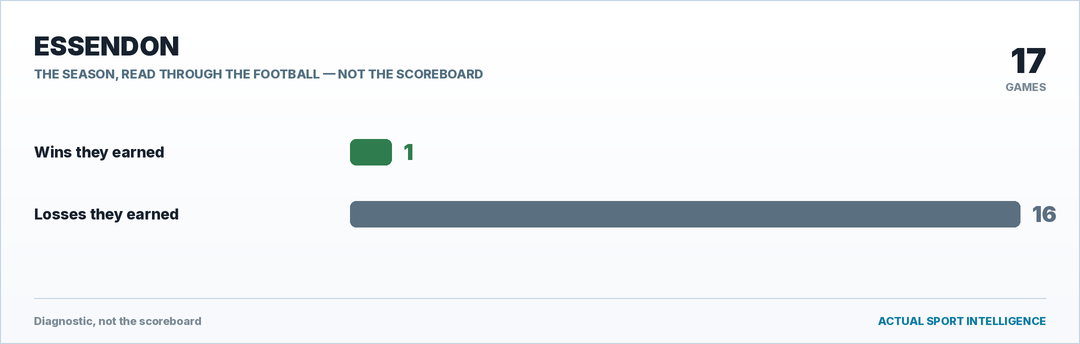
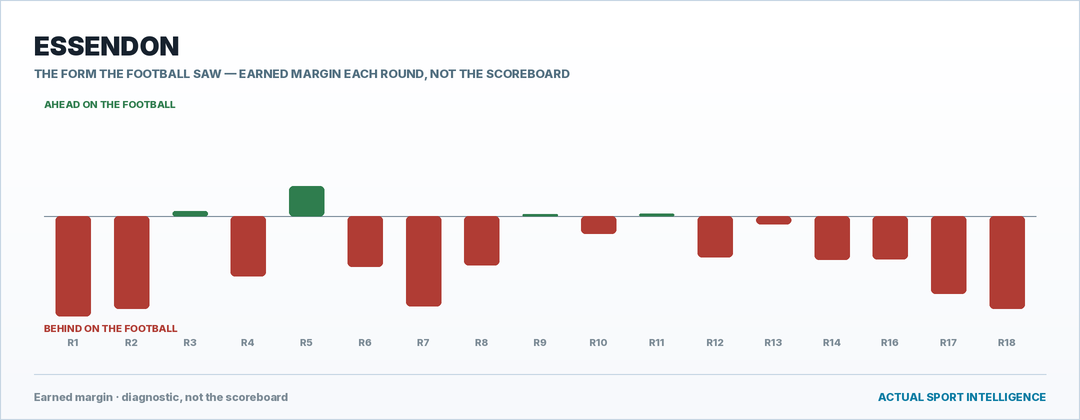
Freshness can trick you. A 90-point margin feels shocking in the moment, but hold it against the standard and the surprise fades. Essendon sit at 1-16. This wasn't the week the wheels came off — the wheels have been off all year.
What makes it notable is the completeness rather than the size. Contested ball, territory, chance quality — Brisbane won the lot. Plenty of big margins are built on one side going clinical for a quarter. This one was built across the ground. Measured against a genuine winning standard, Brisbane looked the part; measured against the season, Essendon looked exactly like a side that's lost 16 of 17.
The players who changed the story wore maroon. Will Ashcroft, Zac Bailey and Kai Lohmann were the most decisive Lions — the ones who turned Brisbane's control of the ball into damage on the scoreboard. In a game won at the source and in the territory battle, those are the names doing the converting, not just the accumulating.
For Essendon, Peter Wright and Sam Durham were the best of a beaten side. Wright in particular carried the headline — in a match where his team got inside 50 far less often, being the focal point of what little went forward is a real contribution, even in a loss. It's the difference between a player who did his job and a scoreboard that refused to reward it.
The outcome-bias test asks: would we believe this reading if the score had been closer? Here the answer is yes, because the football underneath doesn't depend on the final number. Brisbane won the contested ball, won the territory nearly two-to-one, and created the better chances. Strip the 90 away and the story is the same shape.
If anything, the scoreboard slightly overstates it. The result had Brisbane by 90; the football had them by about 80. That gap of ten points is the scoreboard being a touch more emphatic than the play strictly earned — a reminder that margins can run a little ahead of the contest. But the direction and the dominance are real. This isn't a result flattering a performance.
Here's what complicates the blowout story. Essendon weren't blown out of the contest itself. They stayed within touch on the contested ball, and this is a side whose season identity is moving the ball at will — they can generate. Across the year they've actually been clinical, converting better than the raw quality of their chances suggests. So the collapse to 59 isn't a finishing failure; the looks simply weren't there.
Where it broke was disruption — stopping the opposition — which is precisely where Essendon slip all season. Brisbane's near two-to-one territory edge came from Essendon's inability to disrupt the flow, not from being physically dominated at every stoppage. That's a meaningful distinction: a side that can win the ball but can't stem the tide. It doesn't rescue the result, but it reframes where the game was truly lost.
Beneath the 90 points sits a clean contradiction. Essendon's calling card is generating the football and converting it — they move it at will and finish better than their chances deserve. Yet they managed 59. The story isn't that they forgot how to play. It's that when you can't disrupt the opposition, all that ball-movement ability never gets the ball to use.
Brisbane's win was earned across every layer — contest, territory, chance quality — and it worked precisely because it attacked Essendon's known weakness. The Lions didn't need to out-clinical a clinical side; they simply denied them the ground and the looks.
So the real headline isn't 'blowout'. It's a 1-16 side whose one strength was made irrelevant by its one persistent flaw, against an opponent good enough to press exactly there.
What the room agrees on
The room agrees this was a True Win, earned across the board. Brisbane won the contested ball, owned territory nearly two-to-one, and created the better scoring chances — and both sides finished within a whisker of what their looks were worth, so there's no fluke in the scoreline. The 90-point margin runs about ten points ahead of what the football strictly earned, but the direction and the dominance are not in dispute. For a 1-16 side, this is the pattern, not the shock.
Where the room still has tension
The tension sits in what beat Essendon. The football and scoreboard reads see a comprehensive defeat. The counter-case sharpens it: Essendon stayed in touch at the contest and are, on the year, a side that moves the ball at will and converts well. The genuine breakdown was in disruption — their season-long weakness — not at the coalface. So was this a broad hammering, or a specific seam exposed cleanly? The evidence leans toward the second, and that distinction changes how you read Essendon going forward.
What the evidence carries
What survives all seven seats is this: Brisbane were the better side on the day by every measure that matters, and the margin, while a touch generous, reflects a real performance rather than a lucky one. That much the evidence carries firmly.
What it also carries — quietly — is a more interesting truth about the beaten side. Essendon's problem here wasn't finishing or effort at the ball. It was that they couldn't stop Brisbane from owning the ground, which starved their one genuine strength of oxygen. A side that can generate but can't disrupt will keep losing games that look worse than the contest underneath them.
Whether you read this as a routine flogging of a bottom side or as a precise illustration of a fixable flaw — that's the call the evidence sets up but won't make for you. The rest is yours to weigh.
Why it matters — It's the difference between writing off a 1-16 side and understanding exactly which lever is holding them there.